
Dar es Salaam. China’s senior foreign policy figure, Mr Wang Yi, a member of the Political Bureau of the Communist Party of China Central Committee and Minister of Foreign Affairs of the People’s Republic of China, arrived in Tanzania for a two-day official visit running from January 9 to 10, 2026.
His arrival underscores the enduring strategic partnership between Tanzania and China at a time of heightened global geopolitical tensions.
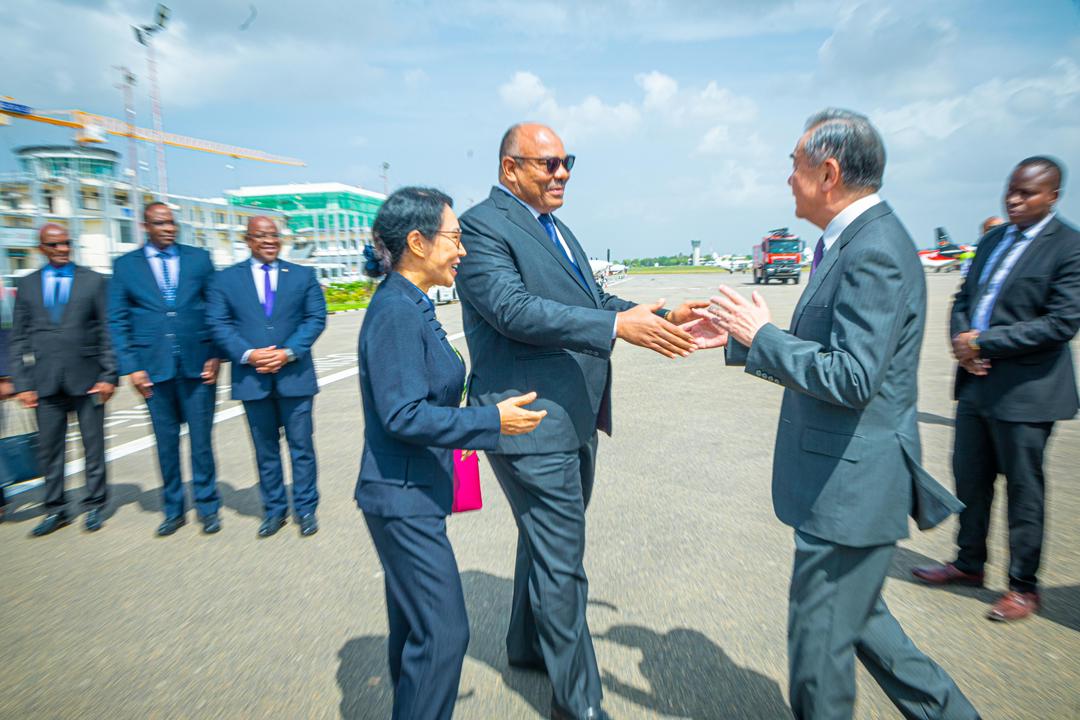
Mr Wang was received at Julius Nyerere International Airport by his host, the minister for Foreign Affairs and East African Cooperation, Amb Mahmoud Thabit Kombo.
The visit is aimed at further consolidating bilateral relations and deepening strategic cooperation between the two countries.
It also seeks to advance economic ties by identifying new areas of collaboration in sectors of shared interest, reflecting the evolving priorities of both nations in a rapidly changing international environment.
During his stay, Mr Wang is scheduled to hold high-level talks with Amb Kombo, discussions expected to focus on strengthening the Tanzania–China strategic partnership and enhancing cooperation across political, economic and development spheres.
He will also pay a courtesy call on President Samia Suluhu Hassan at State House in Dar es Salaam, where he will convey a special message from Chinese President Xi Jinping.
China remains one of Tanzania’s most significant economic partners.
In 2024, bilateral trade between the two countries reached approximately $5.2 billion, while Chinese companies continued to expand their footprint across Tanzania’s industrial, agricultural, services, transport, communications and tourism sectors.
In 2025 alone, the Tanzania Investment and Special Economic Zones Authority (TISEZA) registered 343 Chinese-funded projects valued at about $3.1 billion, generating more than 82,400 jobs.
Cooperation in transport infrastructure has been a defining feature of the relationship, symbolised most notably by the Tanzania–Zambia Railway Authority (TAZARA).
Stretching 1,860 kilometres—975 kilometres in Tanzania and 885 kilometres in Zambia—the railway remains a historic emblem of solidarity, mutual support and shared development aspirations between Tanzania and China.
The visit also highlights a relationship rooted in history, trust and mutual respect, spanning more than six decades.
The foundations were laid by the founding leaders of the two nations, the late Mwalimu Julius Nyerere and the late Chairman Mao Zedong, a legacy that continues to be upheld by successive generations of leaders through tangible cooperation.
Broader geopolitical implications
Beyond its bilateral significance, Mr Wang’s visit takes place against a backdrop of intensifying global geopolitical strains, marked by renewed great-power rivalries, regional conflicts and recent military actions, including the United States’ attack on Venezuela, which has further polarised international relations and unsettled energy and commodity markets.
In this context, China’s sustained diplomatic engagement with Africa, and Tanzania in particular, signals Beijing’s intention to reinforce partnerships in the Global South as part of a broader strategy to promote a multipolar international order.
For Tanzania, the visit reinforces its long-standing foreign policy posture of non-alignment and pragmatic engagement, allowing it to maintain constructive relations with major global powers while prioritising national development goals.
The timing also underscores Africa’s growing strategic relevance amid global uncertainty.
As traditional power centres face diplomatic friction, African countries are increasingly viewed as pivotal partners in trade, investment, infrastructure development and geopolitical alignment.
Tanzania’s stable political environment and strategic location make it an attractive partner for China as it seeks to safeguard supply chains, expand markets and project soft power through development cooperation.
At the same time, the visit highlights the delicate balancing act facing African states.
While deepening ties with China offers clear economic and infrastructure benefits, it also requires careful navigation of broader international dynamics, particularly as tensions between major powers intensify.
Tanzania’s emphasis on mutual respect, sovereignty and development-focused cooperation positions it to engage constructively without being drawn into rival blocs.
Ultimately, Mr Wang Yi’s presence in Dar es Salaam is not only a reaffirmation of a historic friendship but also a reflection of how bilateral diplomacy is increasingly intertwined with global geopolitics.
As international tensions continue to reshape alliances and development pathways, Tanzania–China relations stand as an example of continuity, pragmatism and shared pursuit of stability and growth in an uncertain world.