

London. The Middle East military conflict entered its third day on Monday, with regional instability deepening and global air travel remaining in severe turmoil after widespread airspace closures imposed from the first day of fighting on Saturday.
Air corridors across key Gulf States were shut within hours of the initial escalation, grounding thousands of flights and paralysing some of the world’s busiest transit routes.
Since Saturday, operations at major aviation hubs have remained crippled, leaving tens of thousands of passengers stranded across continents and triggering cascading disruptions to international travel networks.
Flights in and out of Dubai, Doha and Abu Dhabi have been cancelled or diverted for a third consecutive day, as authorities maintained airspace restrictions amid intensifying missile and drone exchanges between Iran, Israel and the United States.
Airlines suspended services across the Middle East and beyond, citing escalating security risks and uncertainty over flight safety.
Transit traffic, which accounts for the bulk of passenger flows through Gulf airports, was hardest hit.
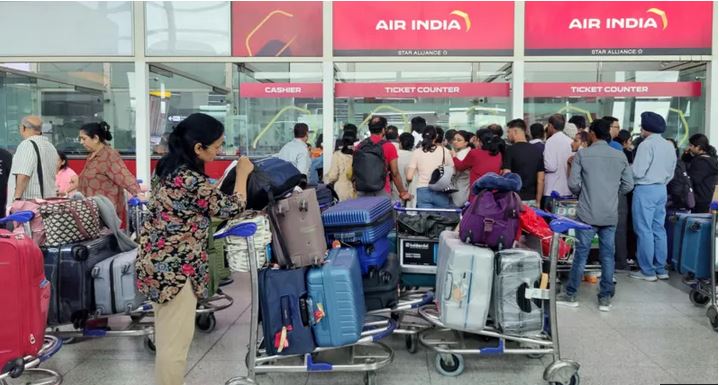
Terminals filled rapidly. Passengers slept on floors.
Long queues formed at airline counters. Rebooking systems were overwhelmed.
Images from airports around the world illustrated the scale of disruption.
In Sydney, travellers sat on terminal floors after their standby flights to Europe via Doha were cancelled.
Similar scenes were reported in Asian, European and African hubs, where transit passengers were left stranded with limited options.
Global airlines said the turmoil could persist if hostilities continue.
Aviation analysts warned that prolonged airspace closures over the Gulf, a critical crossroads of east-west travel, could have lasting implications for global connectivity, cargo movement and airline finances.
The transport crisis unfolded after the United States and Israel launched coordinated strikes on Iran on Saturday, plunging the region into a new and rapidly escalating conflict.
Iran responded with missile and drone attacks, triggering widespread airspace shutdowns across the Middle East.
By Monday, the war had expanded across multiple fronts, with fresh fighting reported in Lebanon and continued exchanges between Iranian, Israeli and US forces.
In Lebanon, Israeli air strikes early on Monday killed at least 31 people, authorities said.
The attacks followed rocket fire by the Iranian-backed Hezbollah group into northern Israel.
Strikes hit southern suburbs of Beirut and areas in southern Lebanon, where Hezbollah holds strong influence.
Israel’s military vowed to escalate its campaign and impose what it described as a “heavy price” on Hezbollah.
It said further operations were being prepared to degrade the group’s capabilities and deter further attacks.
The intensifying conflict prompted the United Arab Emirates to close its embassy in Tehran and withdraw its diplomatic mission after Iranian missile strikes reportedly targeted the Gulf state.
Abu Dhabi condemned the attacks and described them as a violation of sovereignty and international law.
Across the aviation industry, airlines announced sweeping cancellations and route suspensions.
Greece’s Aegean Airlines suspended flights to and from Tel Aviv, Beirut and Erbil through March 3.
Air France cancelled flights to and from Tel Aviv, Beirut, Dubai and Riyadh through March 3, while KLM warned that its services to Dubai, Riyadh and Dammam could be disrupted through March 6.
Flights to and from Tel Aviv were fully suspended.
Air India halted all flights to and from the United Arab Emirates, Saudi Arabia, Israel and Qatar through March 2, and cancelled some services to Europe.
British Airways said passengers flying between London and Abu Dhabi, Amman, Bahrain, Doha, Dubai or Tel Aviv through March 15 could change their travel dates free of charge or seek refunds.
Cathay Pacific cancelled all flights to and from Dubai until March 5 and suspended services to Riyadh through March 3.
Emirates suspended all flights to and from Dubai until at least 1100 GMT on Monday, while Etihad Airways halted all operations from its Abu Dhabi hub until 1000 GMT.
India’s largest airline, IndiGo, suspended all flights that use Middle Eastern airspace until at least March 2.
ITA Airways stopped flights to and from Tel Aviv and said it would not use the airspace of Israel, Lebanon, Jordan, Iraq and Iran until March 7.
Japan Airlines suspended its Tokyo–Doha route, affecting about 1,000 passengers across six scheduled flights.
LOT Polish Airlines cancelled all flights to and from Tel Aviv through March 15.
Lufthansa suspended flights to and from Tel Aviv, Beirut, Amman, Dammam, Erbil and Tehran until March 8, and halted Dubai services until March 4.
Malaysia Airlines suspended all flights to and from Doha, Jeddah and Madinah until March 4.
Norwegian Air halted flights to and from Dubai until March 4.
Singapore Airlines cancelled flights to and from Dubai through March 7, while its low-cost unit Scoot suspended services to Jeddah through the same period.
Qatar Airways temporarily suspended all flights to and from Doha following the closure of Qatari airspace.
Turkish Airlines cancelled some flights to and from Bahrain, Dammam, Riyadh, Iran, Iraq, Jordan, Kuwait, Lebanon, Oman, Qatar, Syria and the United Arab Emirates.
Wizz Air halted flights to and from Israel, Dubai, Abu Dhabi and Amman until March 7.
Industry officials warned that the knock-on effects would extend well beyond the Middle East, affecting flight schedules, aircraft rotations, crew deployment and cargo supply chains across Europe, Asia, Africa and Australia.
Meanwhile, military operations intensified across the region.
In the United States, senior national security officials convened in anticipation of prolonged hostilities.
The Pentagon confirmed that recent strikes against Iranian targets marked its first combat use of one-way attack drones, part of a rapidly assembled low-cost unmanned strike programme.
The drones form part of a new squadron of Low-Cost Unmanned Combat Attack Systems, or LUCAS, developed to provide rapid and economical strike capabilities.
Each unit costs about $35,000, significantly less than conventional armed drones and precision-guided munitions.
Military planners said the systems were designed to overwhelm air defences, destroy missile launchers and degrade radar networks at scale and speed.
Israel also moved its official government aircraft, known as the “Wing of Zion,” to Berlin as a precautionary measure amid heightened security concerns.
The United States military is now racing to weaken Iran’s missile and drone capabilities before interceptor stockpiles are depleted, according to current and former officials.
Analysts warned that sustained operations could place severe strain on air defence systems and ammunition reserves.
President Donald Trump told The New York Times that casualties were expected to rise beyond those already recorded, citing Pentagon projections of heavier losses if the conflict continues.
Kuwait’s defence ministry confirmed that several US military aircraft had crashed in the region, though it did not provide details on the incidents or possible casualties.
Economic fallout is mounting. Energy markets remain volatile, with oil prices swinging sharply amid fears of supply disruption.
Shipping insurers raised premiums for vessels operating in the Gulf, while logistics firms warned of delays, rising costs and mounting uncertainty.
For stranded passengers across global airports, frustration and anxiety are growing.
Airlines said flights would resume only when airspace restrictions are lifted and security conditions stabilise.
Diplomatic efforts to de-escalate the crisis continued, with urgent calls from the United Nations and major powers for restraint.
However, with airspace closed since Saturday, civilian casualties rising, and military operations expanding across multiple fronts, prospects for an early ceasefire appear remote.
As the conflict grinds into its third day, the Middle East faces deepening instability, with far-reaching consequences for global security, energy markets and international travel.