
Dodoma. President Samia Suluhu Hassan has used the occasion of the annual Diplomatic Sherry Party to announce a fundamental recalibration of Tanzania’s foreign and domestic policy.
Unveiling a new doctrine termed Sovereign Pragmatism, President Hassan signaled a departure from traditional development models, moving towards an era of aggressive industrialisation and a ‘multi-engaged’ geopolitical stance.
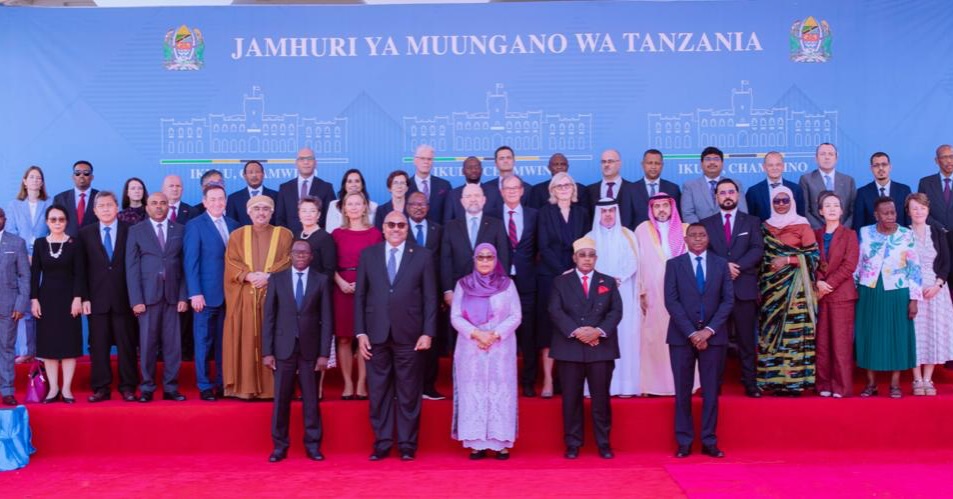
The event, held for the first time at the Chamwino State House in the national capital of Dodoma, served as a symbolic confirmation of the government’s full transition away from the coastal hub of Dar es Salaam.
Addressing a gallery of ambassadors and heads of international organisations, the President presented a vision of a nation seeking to leverage its geographical advantages and natural resources to secure a more assertive role on the global stage, a press statement issued after the party reads in part.
Economic realignment and Dira 2050
The cornerstone of this new doctrine is a rejection of the “aid-dependent” status that has historically defined many East African economies.
“Tanzania is now prioritising trade, technology transfer, and high-value manufacturing over concessional assistance. This shift is encapsulated in the launch of Dira 2050, the Tanzania Development Vision 2050, a long-term roadmap that aims to achieve consistent double-digit economic growth,” President Hassan asserted.
To achieve this, the administration is focusing on three primary pillars.
The first pillar is the Blue and Green Economies, which entails harnessing maritime resources and renewable energy to ensure sustainable growth.
The second pillar is Logistical Supremacy. This has something to do with capitalising on Tanzania’s position as a gateway for the SADC and EAC trade blocs to become a regional transport hub.
The third pillar is Industrial Value Addition entailing moving away from the export of raw materials toward sophisticated processing, particularly in the Liquefied Natural Gas (LNG) and critical minerals sectors.
The economic data President Hassan presented during the meeting suggests a resilient foundation for these ambitions.
She said despite global market instability, Tanzania recorded a GDP growth rate of 5.9 per cent and maintained inflation at 3.3 per cent.
Foreign Direct Investment (FDI) has also seen a significant uptick, with 927 new projects valued at over $11 billion registered as of late 2025.
Geopolitics and Multi-Engagement
In a move that reflects the complex realities of modern diplomacy, the President described Tanzania as “non-aligned but multi-engaged.”
This strategy seeks to balance traditional ties with the Global West against burgeoning infrastructure and industrial partnerships with the Global East.
“By refusing to adhere to a singular sphere of influence, the “Sovereign Pragmatism” doctrine intends to maximise Tanzania’s bargaining power in the global market,” President Hassan noted.
Domestic Reconciliation Following 2025 Unrest
Beyond economics and diplomacy, President Hassan addressed the internal political climate following what she termed as “unprecedented incidents” of 29 October 2025.
In an effort to steer the country toward national healing, she reaffirmed her commitment to the “4Rs” framework: Reconciliation, Resilience, Reforms, and Rebuilding.
As a tangible gesture of this commitment, the President announced the pardoning of 1,787 convicts linked to post-election unrest.
This executive clemency is being coupled with a structured roadmap for constitutional review and the ongoing work of an Independent Inquiry Commission.
These measures appear designed to stabilise the domestic front, ensuring that political friction does not derail the ambitious economic agenda set out in Dira 2050.
Cultural Soft Power
The speech also touched upon the role of Kiswahili in Tanzania’s international relations.
Following the language’s recent recognition by UNESCO, the government is increasingly using it as a tool of cultural diplomacy, positioning it as a unifying African voice in the international arena.
As the convocation concluded, the message to the diplomatic community was clear: Tanzania is attempting to rebrand itself as a transparent, inclusive, and industrially focused frontier market, eager to trade with the world but on its own terms.