
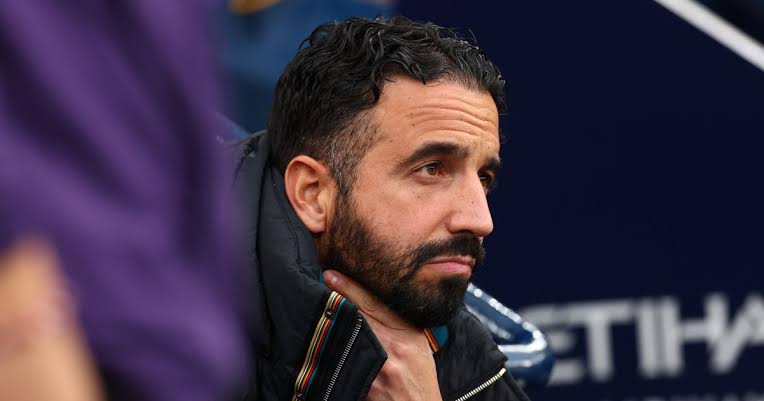
Dar es Salaam. The dismissal of Ruben Amorim after just 14 months at Manchester United was less a sudden decision and more the inevitable conclusion of a deeply flawed experiment.
While the club’s hierarchy cited “emotional and inconsistent behaviour” and tactical inflexibility as the immediate causes, Amorim’s downfall was rooted in a far wider clash between ideology, culture and structural reality at Old Trafford.
Tactical dogmatism in an unforgiving League
At the heart of Amorim’s failure lay an uncompromising devotion to his 3-4-3 system. What had brought him success at Sporting Lisbon became a liability in the Premier League, where adaptability is not optional but essential.
Amorim’s public insistence that “not even the Pope” could persuade him to change the system revealed a rigidity that increasingly alienated players, executives and pundits alike.
Even when evidence mounted, poor defensive numbers, low clean-sheet ratios and one of the weakest points-per-game records in United’s Premier League history, Amorim resisted meaningful evolution.
His brief flirtation with a back four over Christmas appeared more reactive than strategic, and his immediate reversion to a back three against Wolves underlined a manager fighting his environment rather than mastering it.
Breakdown in leadership and trust
Perhaps more damaging than the results was the erosion of trust between Amorim and the club’s leadership.
Meetings with Jason Wilcox and Omar Berrada were reportedly marked by emotional and defensive responses, reinforcing doubts about his capacity to operate within a modern footballing structure that separates recruitment, strategy and coaching.
Amorim’s repeated public declarations that he came to United to be a “manager, not a coach” were telling.
Rather than asserting authority, they exposed insecurity. In a club still redefining governance after years of dysfunction, such rhetoric sounded more like defiance than leadership.
Publicly challenging the hierarchy is rarely survivable at elite clubs, especially without results to justify it.
Statistical Reality: A United manager in name only
The numbers are damning. Amorim recorded the worst points-per-game average of any Manchester United manager in the Premier League era.
His win ratio, goals conceded per match and clean-sheet record all rank at the bottom of the club’s modern history.
United won fewer than a third of their league games under his stewardship and lost exactly one in every three matches overall.
These are not figures that suggest bad luck or transition pains; they point to systemic underperformance.
For a club that still measures itself against elite standards, however unrealistic that may be, the gap between expectation and output became untenable.
Shared Blame, Familiar Pattern
That said, Amorim’s sacking does not absolve United’s hierarchy.
The club once again recruited a manager whose philosophy required time, patience and heavy investment, only to pull the plug before any meaningful squad alignment could occur.
This is a pattern United know all too well: bold appointment, partial backing, cultural clash, dismissal.
Amorim’s frustration over January recruitment and lack of experienced signings, particularly in attack, was not unfounded. Yet elite management demands compromise.
The Premier League punishes ideological purity, and Amorim never truly accepted that reality.
An experiment that never fit
Ruben Amorim’s Manchester United reign will be remembered not as a tragic near-miss, but as a mismatch from the outset.
His ideas were clear, his conviction strong, but conviction without flexibility is fatal at a club as politically complex and tactically unforgiving as United.
Ultimately, this was not just a failure of tactics, but also a failure of alignment: between the manager and the board, philosophy and the squad, and ambition and reality.
Until Manchester United resolve those deeper contradictions, Amorim will not be the last promising coach to leave Old Trafford wondering what might have been.