
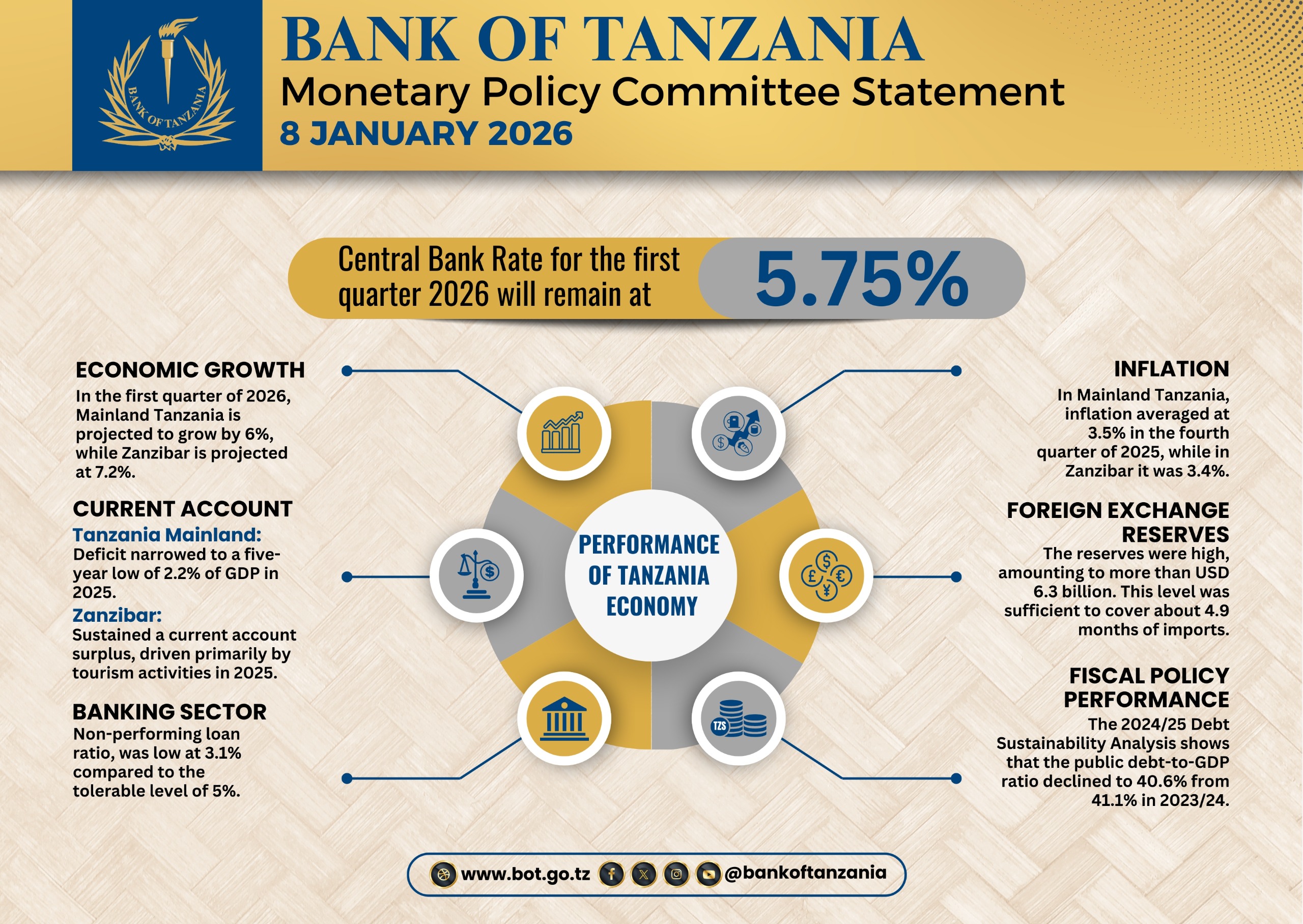
Dar es Salaam. Tanzania’s economic outlook for the first quarter of 2026 remains firmly positive, with growth in Mainland Tanzania projected to hold steady at 6 percent, while the Zanzibar economy is expected to accelerate to 7.2 percent, according to the Bank of Tanzania (BoT).
The upbeat projections were outlined in the Monetary Policy Committee (MPC) Statement released on January 8, following the Committee’s meeting held a day earlier.
In support of sustained growth and macroeconomic stability, the MPC resolved to maintain the Central Bank Rate (CBR) at 5.75 percent for the first quarter of 2026, citing inflation that is expected to remain comfortably within the target range of 3 to 5 percent.
The central bank noted that prevailing economic conditions, both domestically and globally, are conducive to continued expansion.
Resilient global backdrop
The MPC’s assessment of the global economy points to resilience despite persistent headwinds, including elevated trade tariffs, geopolitical conflicts, and lingering uncertainty.
The International Monetary Fund projects global growth of 3.2 percent in 2025, slightly below 3.3 percent in 2024, with a similar pace anticipated in 2026.
Importantly for Tanzania, global inflation has trended downwards, supported by lower energy prices and the delayed effects of tighter monetary policy in major economies.
Crude oil prices, which declined to between $62 and $65 per barrel in the fourth quarter of 2025, are expected to remain at similar levels in early 2026.
This trend offers tangible relief to Tanzania, where oil imports account for about 17 percent of total goods imports, easing pressure on inflation, foreign currency demand, and the exchange rate.
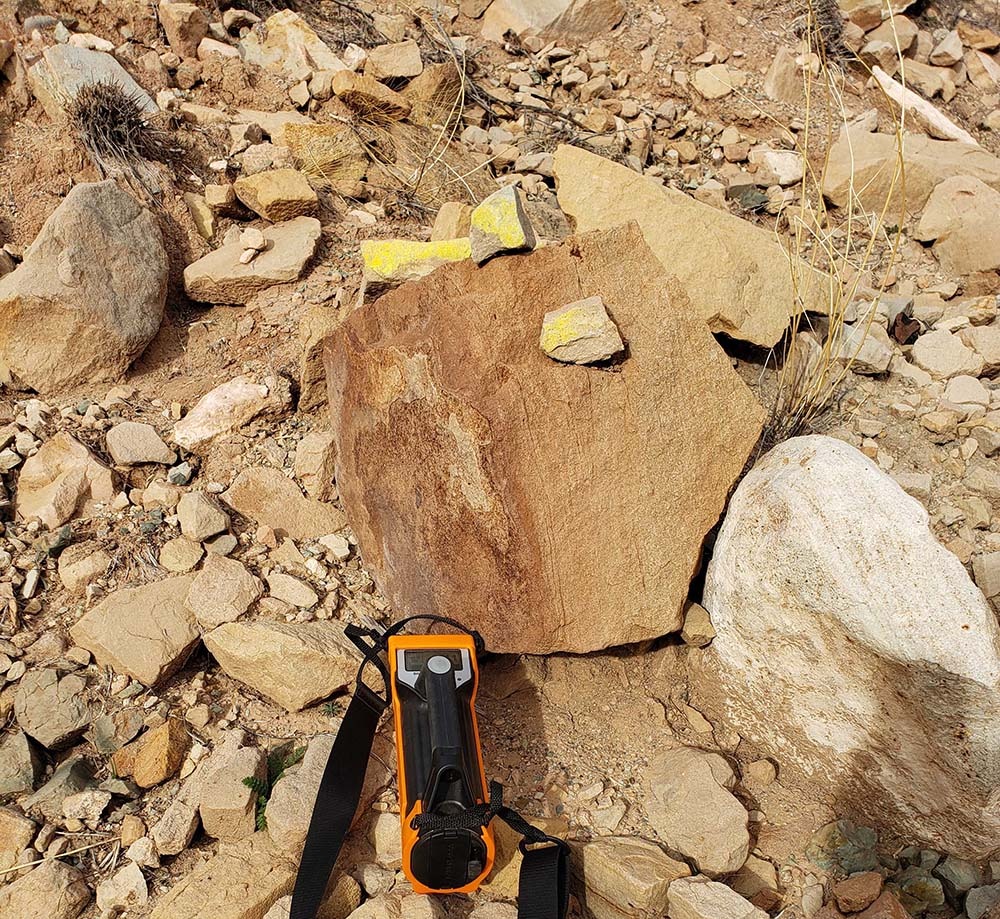
At the same time, gold prices have surged to record highs, reaching $4,421.65 per troy ounce, a development expected to further bolster foreign exchange earnings and currency stability.
Strong domestic fundamentals
Domestically, economic performance in 2025 was assessed as robust, with growth estimated at around 5.9 percent, broadly in line with the earlier projection of 6 percent.
This momentum was underpinned by solid performance in agriculture, mining, and construction.
Zanzibar’s economy expanded by an estimated 6.8 percent in 2025, driven primarily by construction, tourism, and manufacturing.
Looking ahead to the first quarter of 2026, these sectoral dynamics are expected to persist.
Mainland Tanzania’s projected 6 percent growth reflects continued strength in productive sectors and a supportive policy environment, while Zanzibar’s higher projected growth of 7.2 percent underscores the strong rebound and expansion of tourism-related activities and infrastructure development.
Inflation remained subdued towards the end of 2025, averaging 3.5 percent in Mainland Tanzania and 3.4 percent in Zanzibar during the fourth quarter.
The BoT attributed this performance to prudent monetary policy and favourable global conditions that helped stabilise the exchange rate and reduce imported inflation.
Inflation is expected to stay within the 3 to 5 percent target throughout 2026.