

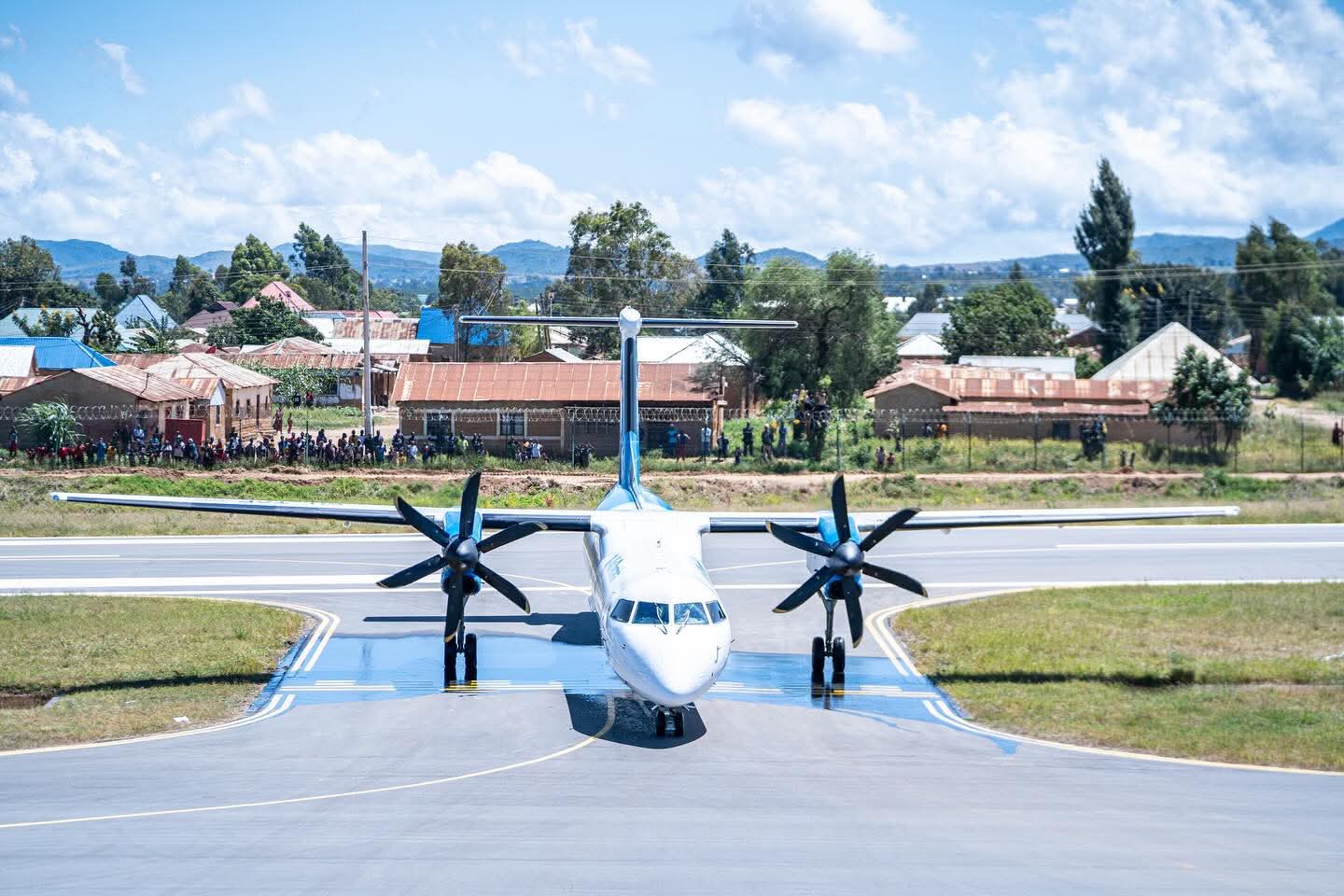
Sumbawanga. A new chapter in Tanzania’s aviation development unfolded on Friday, April 24, 2026, as passenger aircraft operations officially commenced at Sumbawanga Airport, marking a significant milestone for air transport services in the western corridor.
The historic moment was marked by the landing of a lDASH 8 Q400 aircraft operated by Air Tanzania Company Limited, which touched down for the first time at the upgraded facility during the inauguration ceremony.
The event was officiated by Deputy Minister for Transport, David Kihenzile, who represented the government alongside regional leaders, aviation officials and residents.
The launch of operations is expected to ease transport challenges in Rukwa Region and stimulate economic growth through improved connectivity for passengers and cargo.
Improved transport and economic prospects
Officials said the operationalisation of the airport would significantly reduce travel time and improve access to markets for agricultural produce, which remains the backbone of the regional economy.
The upgraded infrastructure includes a rehabilitated runway, improved terminal facilities and modern air navigation systems designed to enhance safety and efficiency.
The airport is also equipped with lighting systems that support night operations, placing it among facilities capable of extended or continuous service.
The development is expected to unlock investment opportunities in trade, tourism and logistics, while strengthening links between Rukwa and major commercial centres such as Dar es Salaam and Dodoma.
Tanzania’s airport network
Tanzania maintains an extensive aviation network comprising dozens of airports and airstrips, with about 58 facilities managed by the Tanzania Airports Authority across the mainland.
In total, mainland Tanzania has roughly 27 recognised airports, complemented by key facilities in Zanzibar such as Abeid Amani Karume International Airport and Pemba Airport.
Major gateways include Julius Nyerere International Airport, Kilimanjaro International Airport, Mwanza Airport and Songwe Airport, which handle both domestic and international traffic.
Airports operating 24 hours
Tanzania has expanded the number of airports capable of round-the-clock operations to about nine facilities, reflecting sustained investment in aviation infrastructure.
These include Julius Nyerere International Airport, Kilimanjaro International Airport, Abeid Amani Karume International Airport, Mwanza Airport, Songwe Airport, Dodoma Airport and Tabora Airport.
Others, including Arusha Airport and Sumbawanga Airport, are either already equipped or transitioning to full 24-hour operations following installation of modern lighting systems.
Key regional airports across the country
Across the country, several regional airports continue to play a critical role in domestic connectivity and economic activity.
In the western and lake zones, Kigoma Airport, Mpanda Airport and Bukoba Airport support passenger travel, trade and tourism, particularly in areas surrounding Lake Tanganyika and Lake Victoria.
In the northern tourism circuit, Arusha Airport remains a key hub linking travellers to national parks and conservation areas.
Along the coast, Tanga Airport facilitates domestic transport and supports fisheries, trade and tourism.
In the southern and southern highlands, Mtwara Airport, Iringa Airport and Songea Airport provide essential links for passengers and cargo, supporting agriculture, mining and emerging energy industries.
Meanwhile, Chato Airport strengthens connectivity in the Lake Zone, while Shinyanga Airport is undergoing major upgrades to enable modern operations, including night flights.
Airports under construction and expansion
The government continues to expand aviation infrastructure to meet rising demand.
Major projects include Msalato International Airport, which is under construction to serve the administrative capital, and Kajunguti International Airport, planned to boost connectivity in the Lake Zone.
There are also proposals for Serengeti International Airport to enhance access to the northern tourism circuit.
A milestone for regional development
The commencement of operations at Sumbawanga Airport represents a significant step in integrating remote regions into the national transport network.
With improved infrastructure and growing connectivity, the facility is expected to serve as a catalyst for trade, tourism and investment in Rukwa and neighbouring regions.
The development underscores the government’s broader strategy to modernise aviation infrastructure, expand 24-hour operations and ensure that air transport plays a central role in Tanzania’s economic transformation.