
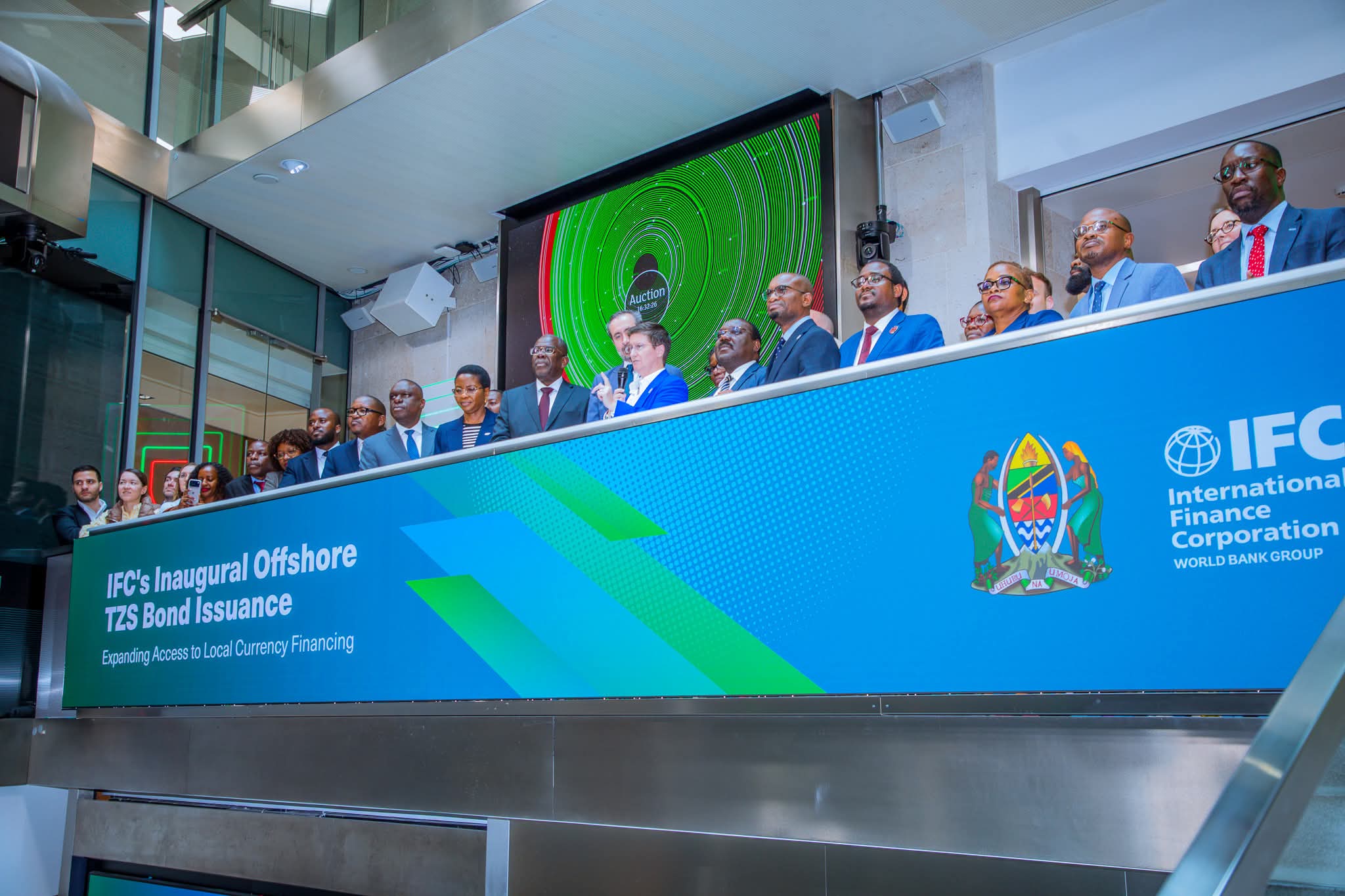
Dar es Salaam/London. Tanzania has reached a significant milestone in international capital markets after its first offshore bond denominated in Tanzanian shillings was listed on the London Stock Exchange.
The $100 million bond, equivalent to about Sh262.5 billion, was issued by the International Finance Corporation (IFC), a member of the World Bank Group.
The proceeds have been channelled to NMB Bank Plc to expand long-term financing for micro, small and medium-sized enterprises (MSMEs) across Tanzania.
Under the financing arrangement, 20 percent of the funds, equivalent to about Sh52.5 billion, has been earmarked to support women-owned businesses.
The listing marks the first time an offshore bond denominated in Tanzanian shillings has been offered to international investors.
It is expected to strengthen Tanzania’s presence in global capital markets while broadening access to long-term funding in the local currency.
Speaking after ringing the ceremonial bell to mark the bond’s launch and the close of trading at the London Stock Exchange, Tanzania’s Minister for Finance, Ambassador Khamis Mussa Omar, described the achievement as a new chapter in the country’s efforts to attract international investors and diversify sources of development finance in support of Tanzania Development Vision 2050.
“This is the beginning of an important step in Tanzania’s journey towards active participation in international capital markets using our own currency. This listing reflects the confidence international financial institutions have in our economy and the direction of our financial sector reforms,” he said.
The minister said listing the bond on one of the world’s leading stock exchanges enhances Tanzania’s international profile and sends a positive signal to investors, strengthening the country’s ability to raise financing at more competitive costs.
“Our objective is not only to ensure the success of this bond in international markets, but also to see its benefits reflected directly in the growth of the private sector, particularly among micro, small and medium-sized enterprises, which remain a key pillar of our economy,” Ambassador Omar added.
NMB Bank Chief Executive Officer Ruth Zaipuna welcomed the transaction, saying the funds would expand the bank’s capacity to provide longer-term loans to small and medium-sized businesses, supporting private sector growth, job creation and productive investment.
She noted that this is the second time NMB has benefited from access to the London capital market.
“In 2023, we secured more than Sh400 billion through a social bond. We have now raised an additional Sh262.5 billion through the first offshore bond listed in Tanzanian shillings,” she said.
World Bank Vice-President and Treasurer Jorge Familiar said the institution was proud to support Tanzania’s efforts to achieve inclusive economic growth under Development Vision 2050.
He said the World Bank’s focus extends beyond the size of investments to the long-term economic and social impact they generate.
Familiar said the investment is expected to support between 13,000 and 20,000 jobs, including opportunities for women, while providing international investors with direct exposure to Tanzania’s growing private sector.
The transaction is widely regarded as a strategic step towards integrating Tanzania more deeply into global financial markets while supporting sustainable and inclusive economic growth.
The IFC has invested more than $1.6 billion in Tanzania across strategic sectors, including infrastructure, agriculture, capital markets and energy.
The investments form part of the World Bank Group’s broader strategy to mobilise private sector financing for the country’s long-term development priorities.
The latest transaction also builds on Tanzania’s ongoing efforts to deepen its financial markets, attract foreign investment and expand access to finance for businesses that drive employment and economic growth.