
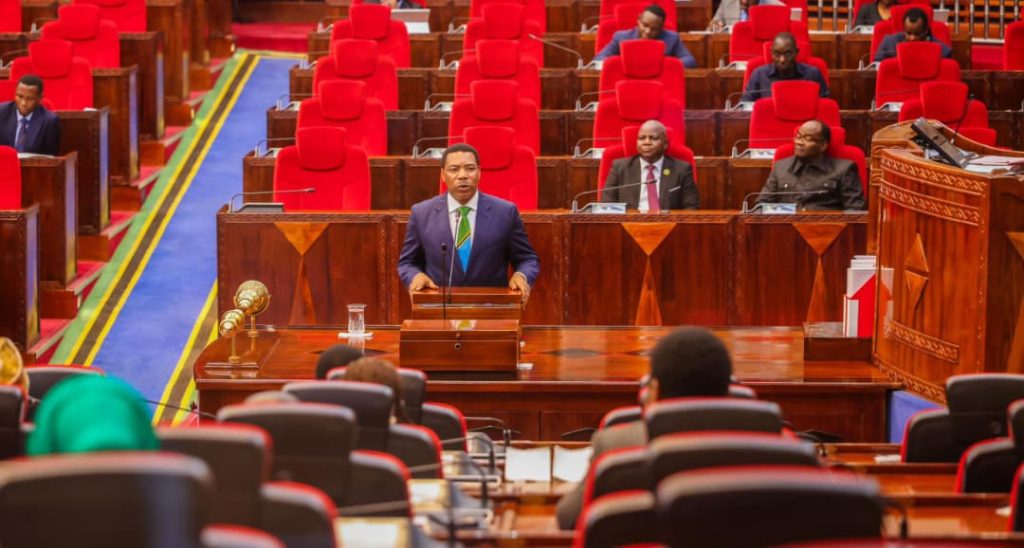
Dodoma. The Prime Minister, Dr Mwigulu Nchemba, has reassured the country that Tanzania remains entirely safe from Ebola.
Addressing parliament during an interactive, prompt question-and-answer session on Thursday, June 4, 2026, Dr Nchemba said the government has significantly fortified its early-warning frameworks, border screening, and public awareness campaigns to prevent any potential outbreak.
He was responding to an inquiry from Asha Salum Moto, a Special Seats Member of Parliament, who sought clarity on the state’s comprehensive contingency plans and preparedness measures in light of recently reported Ebola cases within neighbouring nations.
Dr Nchemba confirmed that no cases of the virus have been detected within domestic borders, expressing profound gratitude for the nation’s current health status.
“Up until now we are safe, our country is safe. It is something to thank God for. However, because Tanzania is not an island, we continue to take all precautionary measures to ensure the safety of our citizens continues to exist,” Dr Nchemba noted.
However, he maintained a stance of strict institutional vigilance, noting that because Tanzania is not an island, the administration continues to execute rigorous precautionary protocols to guarantee the enduring safety and physical security of all citizens.
To mitigate the risk of cross-border transmission, the government has launched a multi-sectoral strategy focused on public health education regarding contagious pathogens, he informed the Parliament.
Furthermore, surveillance networks at key international borders and entry points have been substantially reinforced.
The Prime Minister emphasized the critical importance of early diagnostic reporting, urging citizens to monitor for symptoms and collaborate transparently with medical authorities.
Dr Nchemba appealed directly to the public to strictly adhere to the professional guidance issued by health experts, stressing that individuals must not conceal symptoms or withhold vital epidemiological information that could assist in halting the transmission of communicable diseases.
“Let us continue to observe the advice of health experts, and we must not hide symptoms or information that could help prevent the spread of epidemic diseases,” he said.
Beyond emergency healthcare matters, Dr Nchemba detailed parallel government initiatives designed to address urban growth and stimulate economic productivity through large-scale transport infrastructure development.
Responding to an inquiry by the Member of Parliament for Kigamboni, Haran Sanga, regarding railway expansion in rapidly growing cities, Dr Nchemba outlined strategic urban transit initiatives.
“The government has already started taking various measures, including the construction of ring roads in major cities and completing strategic railway projects. As the financial situation permits, we will also continue to invest in urban railways within our cities,” he said.
Dr Nchemba assured parliament that as national fiscal conditions permit, the administration intends to expand capital investments into localized urban rail infrastructure to alleviate congestion and enhance commercial efficiency.
Agriculture also featured prominently.
In response to a query from the Mvomero legislator, Sarah Msafiri, regarding long-term irrigation plans to boost agricultural yields and satisfy the objectives of the National Development Vision 2050, Dr Nchemba announced a substantial scaling up of state funding for agrarian water management systems.
Given that over 65 percent of the Tanzanian population relies directly on agriculture for their livelihood, Dr Nchemba described modern irrigation as a structural remedy to broader socio-economic challenges, effectively driving production, securing household incomes, and stabilizing national food reserves.
The government has already rehabilitated hundreds of dormant irrigation schemes, expanded water basin management programs, and is actively executing a long-term water distribution grid sourced from permanent bodies to support domestic, agricultural, and pastoral requirements.