
Washington. President Donald Trump has announced plans to impose escalating tariffs on a group of European allies until the United States is granted permission to purchase Greenland, intensifying a dispute over the future of Denmark’s vast Arctic territory.
Posting on Truth Social, Trump stated that an additional 10 percent import duty would come into effect on February 1, on goods from Denmark, Norway, Sweden, France, Germany, the Netherlands, Finland and the United Kingdom — all of which are already subject to previous tariffs imposed by his administration.
He indicated that the tariffs would rise to 25 percent on June 1, and remain in place until an agreement for the acquisition of Greenland is reached.
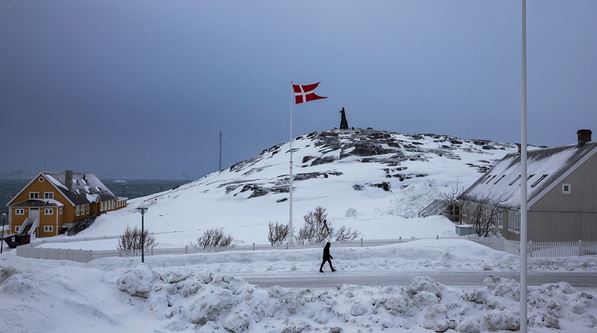
Trump has consistently insisted that the United States must obtain ownership of Greenland, an autonomous Danish territory.
Both Danish and Greenlandic authorities have rejected the proposal, emphasising that the island is not for sale and does not wish to join the United States.
A recent Reuters/Ipsos poll in the United States suggested that fewer than one in five Americans support the notion of acquiring Greenland.
Strategic and Resource Concerns
Trump has argued that Greenland is critical to US security due to its strategic location and abundant mineral resources, and he has not ruled out the use of force to secure it.
Earlier this week, European nations deployed military personnel to the island at Denmark’s request.
“These countries, who are playing this very dangerous game, have put a level of risk in play that is not tenable or sustainable,” Trump wrote.
Protests in Denmark and Greenland were held on Saturday opposing Trump’s demands and calling for the territory to be allowed to determine its own future.
The European nations named by Trump have rallied behind Denmark, warning that any unilateral US military action could undermine NATO and destabilise the alliance.
Denmark’s Foreign Minister, Lars Løkke Rasmussen, described the announcement as “a surprise,” while British Prime Minister Keir Starmer condemned the threat, stating that imposing tariffs on allies who pursue NATO’s collective security is “completely wrong.”
European Commission President Ursula von der Leyen and European Council President António Costa affirmed the EU’s “full solidarity” with Denmark and Greenland, warning that tariffs would damage transatlantic relations and could trigger a “dangerous downward spiral.”
Officials from Norway, Sweden, France and Germany reiterated support for Denmark and urged that Greenland-related discussions remain free of trade sanctions.
Cyprus, which currently holds the EU presidency, announced that it had convened an emergency meeting of ambassadors from the union’s 27 member states on Sunday.
Trade Relations at Risk
Trump’s latest threat could jeopardise tentative trade agreements struck last year with the EU and the United Kingdom, which included baseline import levies of 15 percent on European goods and 10 percent on most British products.
Trade experts have expressed concern that the move to treat certain EU countries differently may prompt European legislators to question the viability of approving trade agreements with the United States.
Trump first hinted at tariffs in relation to Greenland on Friday, though he cited no legal basis for the action.
The president has increasingly used tariffs as a tool to compel both allies and adversaries to meet US demands.
Meanwhile, Danish and other European officials have argued that Greenland’s security is already safeguarded under NATO, and that Trump’s interest appears motivated more by territorial ambitions than defence considerations.
“China and Russia are likely benefiting from divisions among allies,” EU foreign policy chief Kaja Kallas commented on X.
Some US senators also criticised the approach, describing it as detrimental to American interests and transatlantic relations.
Economists have urged Europe to respond cautiously. Carsten Brzeski, global head of macro at ING Research, suggested that the EU “ignore and wait,” noting that the threat of tariffs, while serious, is preferable to the possibility of military confrontation.