
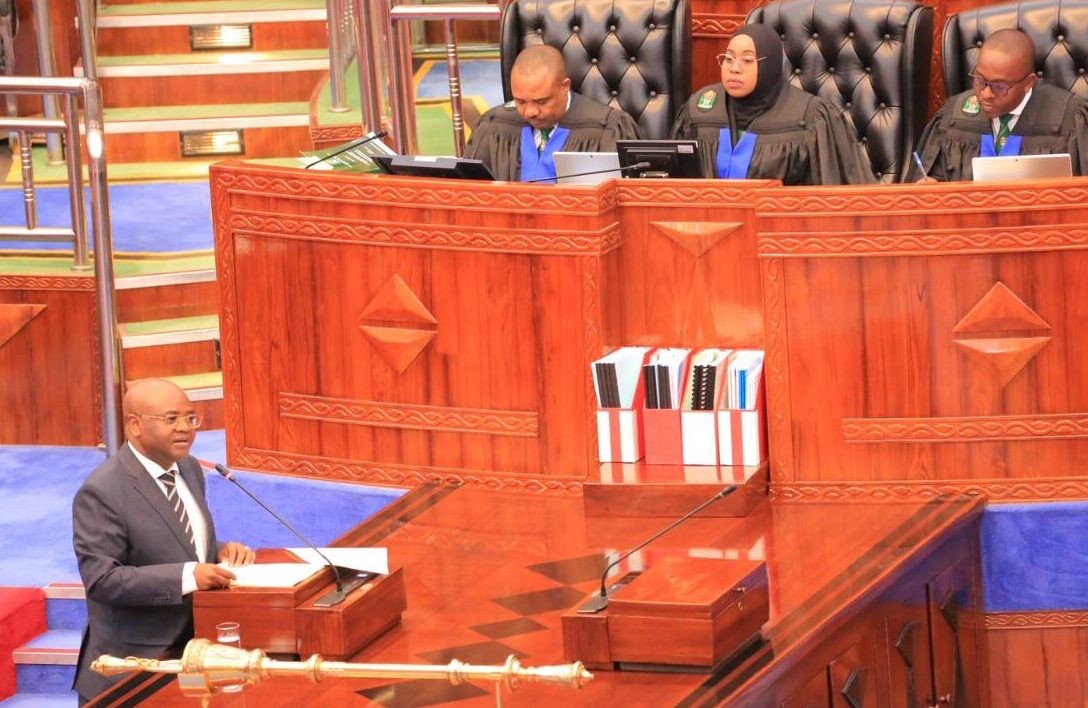
Dodoma. Minister of State in the President’s Office for Planning and Investment, Prof Kitila Mkumbo, has asked Parliament to approve a budget of Sh144.85 billion for the 2026/27 financial year, saying the funds will support the implementation of national development priorities and the execution of the ministry’s core mandates.
He said the allocation comprises Sh126.02 billion for recurrent expenditure and Sh18.83 billion for development projects.
The minister also told Parliament that for the 2026/27 fiscal year the government, through the Office of the Treasury Registrar (OTR), expects to collect Sh1.79 trillion in non-tax revenue, which will be channelled into the Consolidated Fund.
The projection compares with a target of Sh1.69 trillion for the 2025/26 financial year.
On revenue performance for the current financial year, Prof Mkumbo said non-tax revenue had reached Sh773.37 billion by March 2026, up from Sh664.53 billion recorded during the same period in the previous year, indicating improved collection performance.
He explained that the projected revenue will be generated from dividends from public institutions, a 15 percent levy on gross revenues from selected entities, income from the Tanzania Telecommunications Management System (TTMS), loan repayments and interest, as well as other sources.
Turning to priorities for the 2026/27 financial year, the minister said they are anchored in the implementation of Vision 2050, alongside other national development frameworks.
Prof Mkumbo noted that these include the Long-Term Development Perspective Plan, the Fourth Five-Year Development Plan (FYDP IV), the Annual National Development Plan, the 2025 CCM Election Manifesto, and the President’s opening address to the 13th Parliament.
He added that the priorities also reflect newly assigned responsibilities outlined in the Government Gazette issued on December 19, 2025, including private sector development and poverty reduction coordination programmes.
On the implementation of Vision 2050, Prof. Mkumbo said the National Planning Commission will strengthen the use of research, data, and innovation in development planning and execution.
“The government, through the National Planning Commission, aims to ensure that the preparation and implementation of development plans are guided by research findings so as to provide scientific evidence on the real economic and social challenges facing the country,” he said.
This will include the development of a National Research and Innovation Guideline and the establishment of a National Research Portal to store and analyse research outputs for policy and economic decision-making.
He further announced plans to establish an annual National Researchers’ Conference to enhance knowledge sharing and experience exchange among researchers and institutions.
“Once the preparation of Dira 2050 implementation tools is completed, the Planning Commission will focus on monitoring their implementation,” he said.
The government will also closely monitor the implementation of the 2026/27 National Development Plan, including seven flagship programmes and 38 strategic projects, through the National Development Planning Management System.
“The government will continue to educate the public, government institutions, and the private sector on their roles in implementing development plans in order to achieve Vision 2050 targets,” he stressed.
On investment, he said the government will review the Special Economic Zones (SEZ) framework to improve investment incentives and enhance industrial competitiveness.
“In the 2026/27 financial year, the government will ensure the availability of sufficient investment-ready land through the identification of suitable areas, payment of compensation, and development of supporting infrastructure,” he said.
He added: “The government will continue to facilitate, support, and provide services to investors already operating in, and those intending to invest in, Export Processing Zones.”
He further noted that a targeted strategy will be developed to promote investment in vehicle assembly and manufacturing, alongside efforts to strengthen export-oriented production through EPZs.
“To improve access to investment information, in the 2026/27 financial year the ministry will prepare a single compendium of investment incentives across various sectors to make it easier for investors to access information in one place,” Prof Mkumbo said.
On public investment, the government plans to finalise the Public Investment Act, establish a dedicated investment fund, and introduce competitive recruitment for leaders of public institutions.
He said the OTR will continue reforms aimed at improving the performance of public institutions so that they operate efficiently and contribute to the Consolidated Fund in line with Vision 2050 goals.
“It is our expectation that the contribution of public institutions will continue to increase annually through non-tax revenue, employment, production, and service delivery, reaching the target of an 8 percent contribution to the economy by 2050 as outlined in Vision 2050,” he said.
On resource management, he said the government will conduct a national assessment of resources to support productive investment.
“In the 2026/27 financial year, the government, through the National Planning Commission in collaboration with relevant sectors, will assess the country’s resource base in water, land, and minerals to enable productive investment,” he said.