
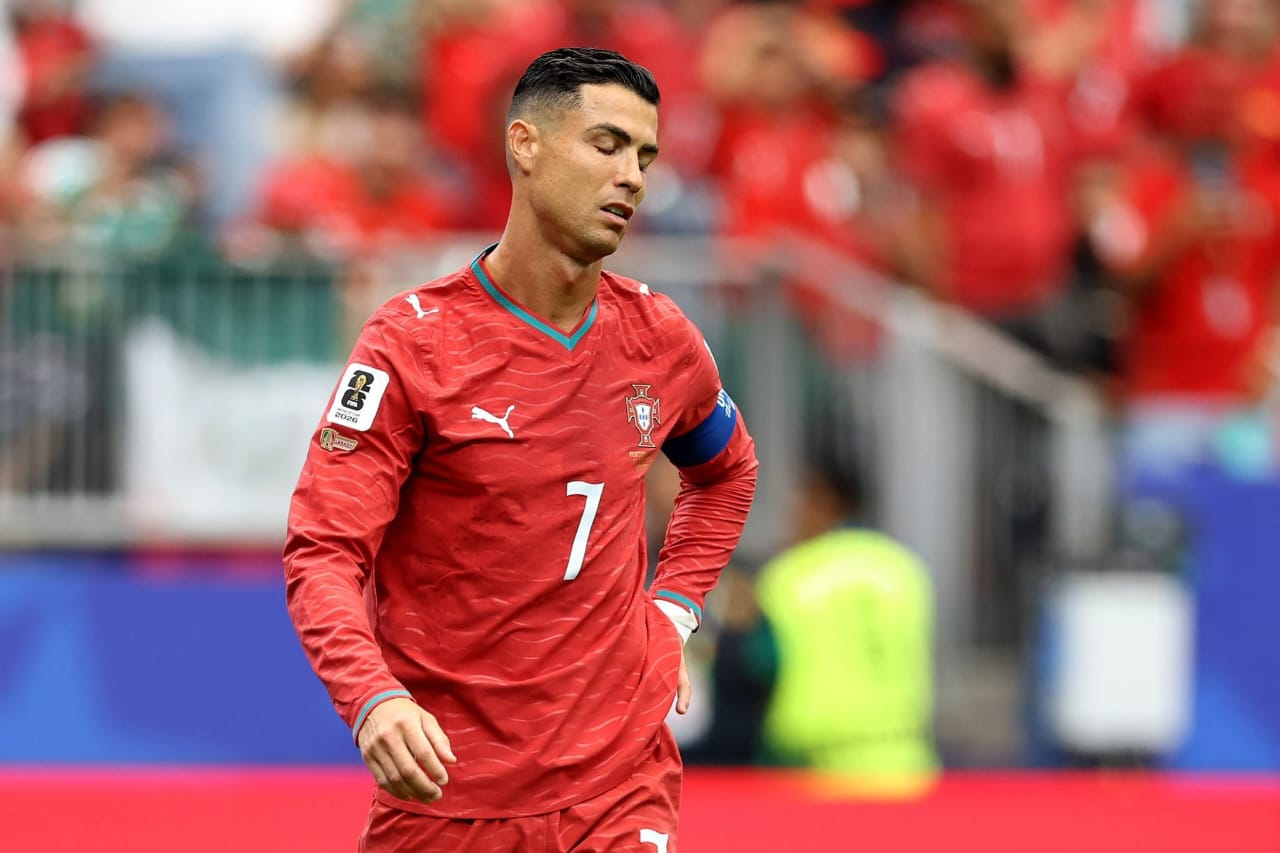
While the opening matches of the 2026 FIFA World Cup have produced moments of brilliance from some of football’s biggest stars, Cristiano Ronaldo has found himself at the centre of attention for very different reasons.
Before Portugal’s clash with DR Congo, everything appeared perfectly set for the Portuguese captain to add another remarkable chapter to his legendary career.
At 41, Ronaldo stepped onto the pitch with the opportunity to become the first player in history to score in six different FIFA World Cups.
Instead of making history, however, he left the field facing criticism as Portugal were held to a disappointing 1-1 draw by DR Congo in one of the tournament’s early surprises.
The result has sparked debate about Ronaldo’s role in the Portuguese national team, his current level of performance and whether coach Roberto Martinez continues to rely on him because of his iconic status or because of what he still offers on the pitch.
Messi, Mbappe and Haaland raise the bar
The pressure on Ronaldo had already increased before kick-off.
Just 24 hours earlier, Lionel Messi had delivered a masterclass, scoring a hat-trick in Argentina’s victory over Algeria.
Those goals saw him draw level with Miroslav Klose as the leading scorer in World Cup history.
At the same time, Kylian Mbappe inspired France with a brace against Senegal, becoming his country’s all-time leading goalscorer.
As if that was not enough, Erling Haaland marked his World Cup debut in style by scoring twice in Norway’s win over Iraq, once again demonstrating why he is regarded as one of the most dangerous strikers in world football.
Ronaldo has always been a player who responds to challenges.
Throughout his long-standing rivalry with Messi, he has often used the achievements of others as motivation to push himself even further.
That is why many expected him to take centre stage in Houston.
Instead, things unfolded very differently.
Portugal dominated possession but lacked cutting edge
Looking purely at the statistics, one could easily assume Portugal controlled the match.
Martinez’s side enjoyed 75 per cent possession, completed significantly more passes than their opponents and spent long periods camped inside DR Congo’s half.
However, football is not decided by possession alone.
Portugal’s biggest problem was their inability to transform that dominance into genuine scoring opportunities.
Across the 90 minutes, they managed only seven shots, with just one on target.
That effort resulted in Joao Neves’ early opener after six minutes.
For a team boasting the likes of Bruno Fernandes, Bernardo Silva, Vitinha, Rafael Leao and Ronaldo, those numbers were far from impressive.
DR Congo, meanwhile, remained disciplined and organised throughout the contest.
They defended with determination and made the most of the limited opportunities that came their way.
Yoane Wissa’s equaliser shortly before half-time completely changed the complexion of the match and forced Portugal to play under increasing pressure.
Ronaldo appeared to be battling time
At the peak of his powers, Ronaldo was a threat every time he touched the ball.
He possessed explosive pace, remarkable strength, outstanding movement and the ability to score from virtually any situation.
Against DR Congo, though, the picture looked very different.
The veteran managed just 25 touches throughout the entire match — fewer than any other Portugal outfield player who completed the full 90 minutes.
Much of the time he appeared to be waiting for service rather than actively participating in the build-up play.
His two best opportunities arrived midway through the second half after impressive work from Francisco Conceicao on the right flank.
On the first occasion, Ronaldo was slightly off balance and guided his effort wide of the post.
Moments later, he received another opportunity but was quickly closed down by DR Congo defenders and sent his finish over the crossbar.
For a player who built his reputation on ruthlessly converting half-chances, those missed opportunities felt symbolic.
Perhaps they were a reminder that even the greatest careers eventually face the challenge of time.
Are Portugal trying too hard to find Ronaldo?
Another major talking point after the match was whether Portugal’s players are overly focused on supplying Ronaldo.
Several times during the game, team-mates appeared to pass up shooting opportunities of their own in favour of looking for the captain.
Former France striker Thierry Henry was among those who questioned that approach.
According to Henry, one of Ronaldo’s movements in the second half actually blocked a potentially dangerous pass towards Bruno Fernandes, who was in a better position to score.
Henry argued that the team’s priority should be finding the best route to goal, regardless of who finishes the move.
His comments reignited a debate that has followed Portugal for years.
Does the team play for Ronaldo, or does Ronaldo play for the team?
Martinez faces a difficult dilemma
Roberto Martinez now finds himself confronted with one of the biggest decisions of his managerial career.
On one hand, he has the greatest goalscorer in international football history, the team captain and one of the most influential players the sport has ever seen.
On the other, he has a talented new generation that appears ready to assume greater responsibility.
Many observers were surprised that Martinez chose not to substitute Ronaldo despite Portugal’s obvious need for fresh attacking energy.
Former England striker Chris Sutton went even further, suggesting the Portugal manager looked reluctant to take his captain off the pitch.
That criticism has only intensified discussion about Ronaldo’s influence within the squad.
The undeniable truth about Ronaldo
Despite the criticism, one fact remains impossible to ignore.
Ronaldo still possesses the ability to change a match in an instant.
His career is filled with examples of games in which he struggled for long periods before producing a decisive goal when it mattered most.
That is why Martinez continues to trust him.
That is why defenders continue to respect him.
And that is why opponents still devote special attention to stopping him.
The challenge, however, is that the 2026 World Cup appears to belong to a new generation of stars operating at the peak of their powers.
Mbappe, at 27, is in his prime.
Haaland combines strength, pace and an insatiable hunger for goals.
Messi, despite advancing age, continues to influence matches with extraordinary quality.
Ronaldo must now prove he can still compete at that level.
DR Congo have changed the group picture
While much of the focus has been on Ronaldo, DR Congo deserve enormous credit for their performance.
The point they earned could become one of the most significant results in the nation’s football history.
They showed courage, discipline and belief against one of the most talented squads in the tournament.
Head coach Sebastien Desabre praised his players’ mental strength and tactical discipline, insisting they executed the game plan exactly as intended.
The result has transformed the dynamics of the group and made Portugal’s path to the knockout stages considerably more complicated than many expected.
End of an era or another Ronaldo revival?
After Messi, Mbappe and Haaland announced themselves in spectacular fashion, Ronaldo’s World Cup campaign has begun under scrutiny.
Yet history suggests writing him off would be a mistake.
Throughout his career, he has repeatedly used doubt and criticism as fuel to achieve even greater success.
The question is no longer whether Ronaldo is one of the greatest footballers of all time.
That debate was settled years ago.
The real question is whether he can still be Portugal’s decisive weapon at the 2026 FIFA World Cup.
The answer may arrive in the matches ahead. For now, while Messi, Mbappe and Haaland enjoy the headlines, Ronaldo finds himself under the spotlight for all the wrong reasons.