
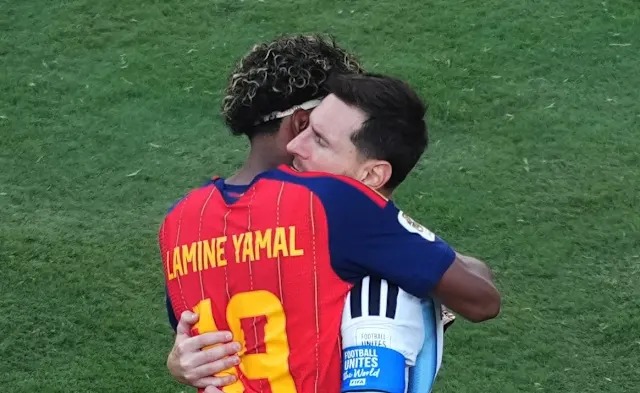
Minutes after Spain defeated Argentina 1-0 to lift the 2026 FIFA World Cup, the defining image of the tournament was not the trophy presentation or the Spanish celebrations.
Instead, it was an emotional embrace between Lamine Yamal and a tearful Lionel Messi a moment that felt like the symbolic passing of football’s crown from one generation to the next.
As Argentina’s players sank to the turf in disappointment, Messi stood motionless, absorbing the deafening chants of thousands of Argentine supporters inside New York New Jersey Stadium.
At 39, the legendary captain appeared to be saying goodbye to the biggest stage in world football, receiving one final standing ovation from fans who have followed him through nearly two decades of international glory and heartbreak.
Then came Yamal.
The 19-year-old Spain star walked over to console his childhood idol before the pair shared a heartfelt embrace.
It was a scene loaded with symbolism: the greatest player of the modern era comforting, and perhaps unknowingly handing the baton to, the sport’s brightest new superstar.
The image carried even greater significance because of a remarkable piece of football history.
In 2007, a 20-year-old Messi took part in Barcelona’s annual charity calendar, posing while bathing a six-month-old baby named Lamine Yamal.
Nineteen years later, that same child stood before him as a World Cup winner, having helped end Argentina’s reign.
Yamal’s meteoric rise
At just 19 years and six days old, Yamal has already achieved what many elite footballers spend an entire career chasing.
Having inspired Spain to victory at Euro 2024, he has now added the 2026 FIFA World Cup, becoming the youngest player ever to win both major international titles.
His achievement is even more remarkable considering he entered the tournament nursing a hamstring injury.
Rather than being restricted, he developed into one of Spain’s most influential performers throughout the competition and delivered another composed display on football’s biggest occasion.
Spain’s triumph also preserved Yamal’s extraordinary unbeaten record in competitive internationals.
He has now featured in 28 competitive matches without suffering defeat, while winning all 13 major tournament starts an unprecedented record for a European player of his age.
Alongside fellow 19-year-old defender Pau Cubarsí, Yamal also entered football history as one of the youngest players ever to start and win a World Cup final.
Only Pelé (1958), Giuseppe Bergomi (1982) and Kylian Mbappé (2018) had previously achieved comparable feats at such a young age.
Spain head coach Luis de la Fuente praised not only Yamal’s talent but also his maturity.
“I’m incredibly grateful to Lamine. He produced another outstanding performance, but what impresses me most is his commitment to the team. He’s still developing, and his future is even brighter,” said the Spain manager.
Mature beyond his years
Yamal’s display against Argentina underlined qualities extending far beyond technical ability.
Throughout the final he was repeatedly targeted by Argentina’s experienced defenders, particularly Nicolás Tagliafico, who attempted to disrupt his rhythm with a series of physical challenges.
Yet the teenager refused to be drawn into confrontation.
Former England goalkeeper Joe Hart highlighted Yamal’s composure as the characteristic that separated him from most young talents.
“He never lost his composure. He didn’t retaliate, he wasn’t intimidated, and he kept making the right decisions. Argentina tried everything to stop him, but he remained calm throughout. When you remember he’s only 19, it’s extraordinary to think he’s already achieved so much in international football,” Hart observed.
With experienced leaders such as Rodri alongside him, many believe Yamal is only beginning what could become one of football’s greatest international careers.
A painful farewell for Messi
While Yamal celebrated the biggest triumph of his young career, the evening represented the opposite for Messi.
Following the final whistle, the Argentina captain stood in silence, staring into the stands as supporters continued singing his name.
The emotional scenes strengthened the widespread belief that this was his final appearance at a FIFA World Cup.
Even Argentina manager Lionel Scaloni struggled to discuss the subject.
Asked during his post-match press conference whether the final marked the end of Messi’s World Cup journey, Scaloni became visibly emotional, paused midway through his answer, and eventually walked away in tears.
Argentina abandoned their identity
Argentina’s defeat was not simply the result of Spain’s quality it also reflected their own tactical shortcomings.
Instead of reproducing the fluid, possession-based football that eliminated England in the semi-finals, the reigning champions became increasingly physical and reactive.
Referee Slavko Vinčić allowed several robust challenges during the opening stages before finally producing yellow cards.
Alexis Mac Allister escaped an early booking following a heavy challenge on Dani Olmo, while Lisandro Martínez eventually entered the referee’s notebook in the 40th minute after bringing down Mikel Oyarzabal.
Messi himself became involved in a heated exchange with the officials, urging Vinčić to dismiss Marc Cucurella during one flashpoint.
Argentina’s problems worsened shortly before extra time when Enzo Fernández received a second yellow card after launching into Pau Cubarsí without making any genuine attempt to play the ball.
Numbers that exposed the champions
The statistics painted an alarming picture of Argentina’s performance.
Across the full 90 minutes, they failed to register a single shot on target, becoming the first team in World Cup final history to do so.
Their first meaningful effort arrived only in the 117th minute through Messi, but even that failed to test Spain’s goalkeeper.
Spain, by contrast, recorded 12 shots on target, consistently forcing Argentina onto the back foot.
The South Americans also committed nine fouls during the first half alone and completed only eight passes in the final third, illustrating how their focus shifted from controlling possession to disrupting Spain’s rhythm.
A disappointing ending
The final whistle brought more than tears.
Brief confrontations broke out between players, with Leandro Paredes appearing to grab Eric García by the throat before also becoming involved in an incident that left Gavi on the ground.
It was an untidy conclusion to a final that many expected to celebrate another chapter in Messi’s remarkable international legacy.
Instead, it marked the beginning of a new era.
Spain completed an extraordinary tournament after opening their campaign with a surprising draw against Cape Verde before steadily growing into the competition’s dominant force.
And if this final truly signalled the closing chapter of Lionel Messi’s World Cup story, football may also have witnessed the official arrival of its next global icon.
The tears belonged to Messi. The future, unmistakably, belongs to Lamine Yamal.