

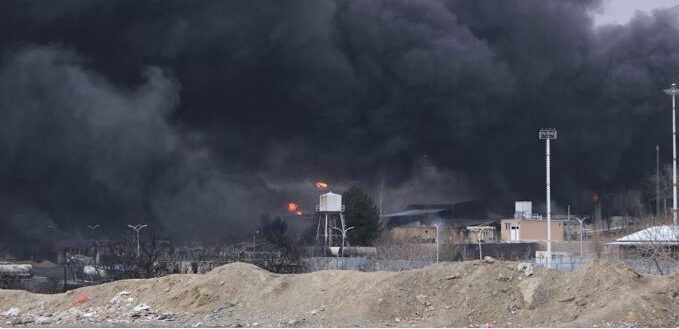
London. Global stock futures fell sharply on Monday as oil prices surged past the $100-a-barrel mark, heightening investor anxiety over the escalating conflict in the Middle East.
Futures tied to the Dow Jones Industrial Average dropped about 1.5 percent after plunging nearly 1,000 points in overnight trading.
Contracts linked to the S&P 500 and the Nasdaq 100 also declined by roughly 1.3 percent and 1.5 percent respectively.
However, all three indices later recovered slightly from deeper earlier losses that had exceeded 2 percent.
The market turbulence followed a dramatic spike in oil prices.
Crude rose as much as 25 percent late on Sunday as fighting in Iran disrupted production and shipping routes across the Gulf region.
The Strait of Hormuz, one of the world’s most important oil transit corridors, remains closed, intensifying fears of a prolonged supply disruption.
Kuwait confirmed it had cut oil production, though authorities did not disclose the scale of the reduction.
Meanwhile, output in Iraq has reportedly plunged by about 70 percent, further tightening global supply.
As concerns about shortages mounted, finance ministers from the Group of Seven (G7) major economies prepared to discuss a potential co-ordinated release of emergency petroleum reserves.
The move would be organised through the International Energy Agency (IEA) in an attempt to stabilise markets and ease price pressures.
According to people familiar with the discussions, three G7 countries, including the United States, have expressed support for the proposal.
West Texas Intermediate crude futures were trading at about $103 a barrel, while global benchmark Brent crude was changing hands above $107.
Both benchmarks remained roughly 15 percent higher despite retreating from earlier peaks.
The sell-off in global equities follows a difficult week for markets.
The Dow Jones Industrial Average lost around 3 percent last week, marking its steepest weekly decline since market volatility linked to tariff concerns during the Trump administration in April 2025.
The S&P 500 slipped nearly 2 percent over the same period, while the Nasdaq Composite ended the week more than 1 percent lower.
Investors are also closely monitoring key economic data scheduled for release this week.
The United States Consumer Price Index is due on Wednesday, followed by the Personal Consumption Expenditures index on Friday.
Analysts note, however, that the data may not yet reflect the latest surge in oil prices.
Meanwhile, the corporate earnings season continues. Hewlett Packard Enterprise is expected to report results after Monday’s closing bell, with Oracle, Adobe and Dick’s Sporting Goods also scheduled to release earnings later in the week.
G7 finance ministers and the IEA’s executive director, Fatih Birol, were expected to hold an emergency call on Monday morning to assess the impact of the conflict and discuss possible responses.
The IEA’s 32 member states collectively hold about 1.2 billion barrels in strategic reserves.
Some US officials reportedly believe a co-ordinated release of between 300 million and 400 million barrels, equivalent to roughly a quarter of the total stockpile, could help calm markets and prevent further price shocks.