
Dubai. Iran’s Revolutionary Guards said on Tuesday that they would not allow any oil shipments from the Middle East if US and Israeli attacks continue, prompting US President Donald Trump to warn that Washington would respond with far greater force if Tehran attempted to block exports.
The strong rhetoric failed to halt a decline in crude oil prices or a rally in global equities that followed Mr Trump’s earlier expression of confidence that the conflict could end swiftly, even after Iran signalled defiance by naming Mojtaba Khamenei as its new supreme leader.
Mr Trump said on Monday that the United States had inflicted serious damage on Iran’s military capabilities.
He also predicted that the conflict would conclude sooner than the initial four-week time frame he had outlined, although he has not clarified what would constitute victory.
Israel has stated that its objective in the war is to dismantle Iran’s system of clerical rule.
“Our aspiration is to enable the Iranian people to cast off the yoke of tyranny,” Israeli Prime Minister Benjamin Netanyahu said in a statement issued by his office on Tuesday.
“In the end, that depends on them. But there is no doubt that through the actions taken so far we are breaking their bones — and our hand is still extended,” he said.
“If we succeed together with the Iranian people, we will bring about a permanent end — if such things exist in the life of nations.”
US officials have largely said Washington’s goal is to destroy Iran’s missile capabilities and nuclear programme.
However, Mr Trump has also suggested that the conflict can only end with the emergence of a compliant Iranian government.
At least 1,332 Iranian civilians have been killed and thousands wounded since the United States and Israel launched air and missile strikes across Iran at the end of February, according to Iran’s ambassador to the United Nations.
Mr Trump warned that US military action could escalate significantly if Iran attempted to block tanker traffic through the Strait of Hormuz, a strategic waterway that carries about one-fifth of the world’s oil supply.
“We will hit them so hard that it will not be possible for them, or anybody helping them, to ever recover that section of the world,” Mr Trump told a press conference on Monday.
Iran says it will determine the war’s end
The Islamic Revolutionary Guard Corps said it would prevent oil exports from the region if attacks by the United States and Israel continued.
“We are the ones who will determine the end of the war,” a spokesperson said, describing Mr Trump’s comments as “nonsense”, according to Iranian state media.
In a later post on Truth Social, Mr Trump reiterated his warning.
“If Iran does anything that stops the flow of oil through the Strait of Hormuz, they will be hit by the United States of America twenty times harder than they have been hit thus far,” he wrote.
Saudi Aramco, the world’s largest oil exporter, warned on Tuesday of “catastrophic consequences” for global oil markets if the conflict continued to disrupt shipping through the Strait of Hormuz.
The strait is the most important oil export route in the world, linking major Gulf producers with the Gulf of Oman and the Arabian Sea.
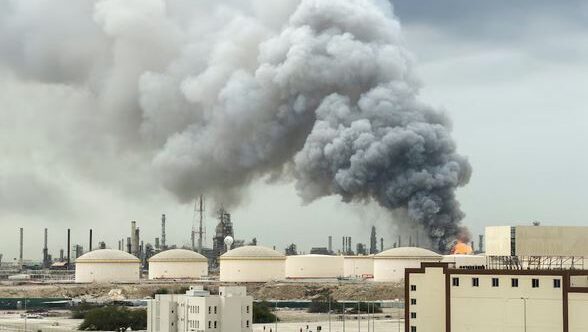
The conflict has already effectively closed the passage, with tankers unable to sail for more than a week and producers forced to halt pumping as storage facilities fill.
Iranian Foreign Minister Abbas Araqchi said Tehran was unlikely to resume negotiations with Washington, which he said had previously indicated progress after three rounds of talks.
“Still, they decided to attack us. So I do not think talking to the Americans would remain on our agenda,” he said in an interview with PBS.
The appointment on Monday of Mojtaba Khamenei to succeed his slain father, Ayatollah Ali Khamenei, appeared to dash hopes of a swift resolution to the war, sending oil markets sharply higher and global equities tumbling.
Markets later reversed course after Mr Trump predicted the conflict would end quickly and reports emerged of a possible easing of sanctions on Russian energy.
Following a conversation with Russian President Vladimir Putin, Mr Trump said the United States would waive oil-related sanctions for “some countries” in an effort to ease supply shortages.
According to multiple sources, the move could involve further relaxation of sanctions on Russian oil, a step that may complicate efforts to punish Moscow over its war in Ukraine.
Other options being considered include releasing oil from strategic reserves or restricting US exports, sources said.
Brent crude futures fell by more than 10 percent on Tuesday after surging by as much as 29 percent on Monday to their highest level since 2022.
Global stock markets also rebounded.
Fuel prices carry strong political implications in the United States, where voters frequently cite rising costs as a major concern ahead of the November midterm elections, in which Mr Trump’s Republicans will attempt to retain control of Congress.
A Reuters/Ipsos poll released on Monday found that 67 percent of Americans expect petrol prices to rise in the coming months, while only 29 percent approve of the war.