
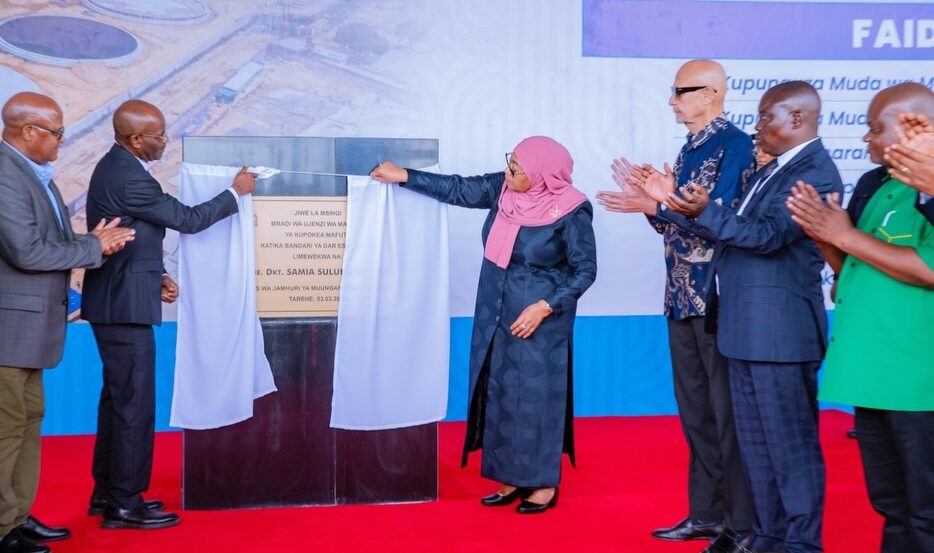
Dar es Salaam. President Samia Suluhu Hassan has laid the foundation stone for a strategic oil storage project at the Port of Dar es Salaam, marking a significant step in efforts to strengthen energy security and modernise transport infrastructure.
The project involves the construction of new tanks for the reception and distribution of petroleum products.
It forms part of the government’s broader strategy to improve logistics systems and position Tanzania as a competitive regional trade and energy hub.
Speaking at the ceremony in Dar es Salaam on March 3, 2026, President Hassan said the investment would enhance the country’s capacity to receive and store fuel.
She noted that it would also address longstanding operational bottlenecks and reinforce national energy security.
She said the development aligns with the government’s infrastructure modernisation agenda.
“The objective”, she added, “is to ensure reliable fuel supply for domestic consumption and industrial growth, while improving efficiency at the port.”
The President also highlighted reforms undertaken at the port, including greater private sector participation.
She said the measures had improved efficiency, expanded cargo handling capacity and increased government revenue.
According to her, the new storage tanks will reduce vessel turnaround time for fuel imports.
“The tanks are expected to ease congestion and enhance the reliability of supply chains linked to petroleum products,” she noted.
The project is also connected to plans for establishing National Strategic Petroleum Reserves.
The initiative is designed to increase the country’s resilience to global supply disruptions and price volatility.
The minister for Transport, Prof Makame Mbarawa, said the government is integrating port services with the Standard Gauge Railway.
He said the freight service between Dar es Salaam and Dodoma will commence formally, alongside the development of inland dry ports in Morogoro, Dodoma and Shinyanga.
The integration is expected to streamline cargo flows from the port to the hinterland.
It is also intended to reduce congestion and lower logistics costs.
The Director General of the Tanzania Ports Authority (TPA), Mr Plasduce Mbossa, said the project will significantly cut the time required to handle fuel vessels.
He said discharge time per vessel will fall from an average of 22 days to seven days.
He added that the reduction would save an estimated $25,000 in demurrage costs per vessel.
The savings are expected to translate into lower operational expenses and more competitive fuel prices.
Mr Mbossa said the improved efficiency would attract more vessels and boost port revenues.
He described the project as part of a wider master plan to enhance the competitiveness and contribution of the maritime sector to the national economy.
The project is being implemented by TPA at a cost of Sh701.8 billion.
Implementation has reached 41 percent. About Sh117.1 billion has been paid for design and consultancy services.
Construction began in August 2024 and is scheduled for completion in February 2027.
Upon completion, the facility will comprise 15 storage tanks with a total capacity of 378,000 cubic metres.
The tanks will include capacity for diesel, petrol and Jet A1 aviation fuel.
The additional infrastructure will raise the port’s overall fuel handling capacity from 1,051,888.52 cubic metres to 1,429,888.52 cubic metres. This represents an increase of 35.9 percent.
Officials said the expansion will strengthen fuel availability and improve price stability.
It is also expected to consolidate the Port of Dar es Salaam as a regional energy gateway serving neighbouring countries.