

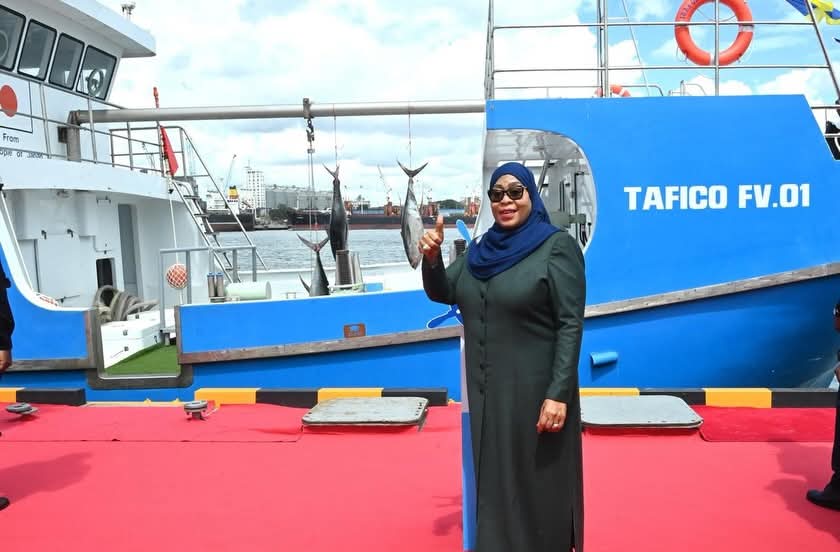
Dar es Salaam. President Samia Suluhu Hassan has officially launched Tanzania’s first government-owned deep-sea fishing vessel, marking a historic step in the country’s drive to expand the blue economy and strengthen domestic participation in offshore fishing.
The launch ceremony took place on April 25, 2026, at the headquarters of the Tanzania Fishing Corporation (TAFICO) in Kigamboni, Dar es Salaam.
The event signalled the beginning of a new phase in the country’s efforts to modernise the fisheries sector and reduce reliance on foreign fishing fleets.
Historic milestone for fisheries sector
The commissioning of the vessel represents the first time Tanzania has owned and operated a deep-sea fishing vessel under direct government control.
Officials described the development as a turning point in the utilisation of the country’s vast marine resources.
Speaking ahead of the launch, the Minister for Livestock and Fisheries, Bashiru Ally Kakurwa, said the initiative demonstrates the government’s commitment to strengthening national capacity in offshore fishing operations.
He noted that the acquisition of the vessel would enable the country to harvest marine resources more efficiently and ensure that greater economic value remains within the domestic economy.
Government officials emphasised that the introduction of a state-owned deep-sea vessel is expected to enhance productivity and support industrial-scale fishing activities, particularly in offshore waters that have historically been dominated by foreign fleets.
Part of broader blue economy strategy
The launch forms part of a wider national strategy aimed at developing fisheries infrastructure and strengthening value chains from harvesting to processing and export.
Authorities have repeatedly underscored the importance of modern equipment and infrastructure in raising output and improving incomes for coastal communities.
The government has invested heavily in fisheries infrastructure, including the development of the Kilwa Masoko Fisheries Port in Lindi Region.
The project, valued at about Sh280 billion, had reached approximately 97 percent completion by April 2026, with remaining work focused on installing specialised equipment ahead of commissioning.
Once operational, the Kilwa facility is expected to support fishing operations, storage, and processing activities, thereby strengthening the national fisheries value chain and expanding export potential.
Expanding domestic control of marine resources
Officials have indicated that Tanzania’s deep-sea resources remain underutilised despite the country’s extensive coastline along the Indian Ocean.
Investments in vessels and infrastructure are intended to enable local participation in offshore fishing and reduce dependence on foreign operators.
Government leaders have also stressed that strengthening domestic fishing capacity will improve national revenue collection and increase employment opportunities across the fisheries value chain, including transport, processing, and logistics services.
Preparations for deep-sea fishing operations had already been initiated earlier as part of broader reforms in the fisheries sector.
These reforms aim to expand productivity and maximise benefits from both marine and inland water resources.
Strengthening industrial fishing capacity
The newly launched vessel is expected to play a key role in establishing Tanzania’s presence in industrial-scale deep-sea fishing.
Experts have noted that such vessels are capable of operating in distant waters and harvesting species that are not accessible to small-scale fishing boats.
Government officials believe that operating its own deep-sea vessel will enable Tanzania to generate reliable data on fish stocks and improve regulatory oversight in offshore waters.
This development is also expected to strengthen monitoring and management of marine resources.
Earlier reports indicated that a 22-metre deep-sea fishing vessel had arrived in the country as part of investments intended to generate tangible output from blue economy initiatives.
Economic and employment impact
Authorities expect the launch to contribute significantly to employment creation, particularly among coastal communities that depend heavily on fisheries for their livelihoods.
The expansion of deep-sea fishing operations is also projected to stimulate growth in associated industries such as cold storage, packaging, transportation, and export logistics.
The Kilwa Masoko Fisheries Port project alone is projected to create tens of thousands of jobs once fully operational, reflecting the broader economic potential of investments in fisheries infrastructure.
Government officials have further stated that strengthening the fisheries sector aligns with national plans to diversify sources of income and expand non-traditional exports.
Fish and fish products remain among Tanzania’s key export commodities, and improvements in industrial fishing capacity are expected to enhance competitiveness in regional and international markets.
Continuing investments in modernisation
The launch of the deep-sea fishing vessel builds on earlier initiatives aimed at modernising the fishing industry.
In recent years, the government has implemented programmes to supply modern fishing boats to local operators and strengthen safety and navigation systems.
These efforts reflect a long-term commitment to transforming fisheries into a major contributor to economic growth.
Authorities have emphasised that continued investment in vessels, ports, and technical skills will be necessary to sustain productivity and ensure responsible management of marine resources.
Strategic outlook for the blue economy
The introduction of Tanzania’s first government-owned deep-sea fishing vessel is widely regarded as a foundational step towards industrialising the fisheries sector.
It also signals the country’s intention to maximise returns from its maritime resources and enhance national participation in offshore fishing activities.
Officials have reiterated that the expansion of the blue economy remains a national priority, with additional investments planned in infrastructure, training, and technology.
The government expects these measures to position Tanzania as a competitive player in the global fisheries industry while ensuring that citizens benefit directly from marine resources.