
For more than 20 years, the world of football has been divided into two major camps.
One camp believes Lionel Messi is the greatest player of all time, while the other stands firmly behind Cristiano Ronaldo as the defining king of this generation.
Debates, arguments, statistics, trophies and records have all been set and broken by these two names for over two decades, as the world has witnessed an extraordinary rivalry unlike anything seen in the history of modern football.
But now, the world appears to be approaching the end. The 2026 FIFA World Cup could be the final “Last Dance” for Messi and Ronaldo on football’s biggest stage, a reality already stirring strong emotions among fans across the globe.
For years, these two superstars have broken almost every possible record.
They have collected countless trophies, carried their teams in difficult moments, and completely transformed the way football is perceived worldwide.
They have played in the biggest stadiums on earth, scored in the most important matches, and created a rivalry that may not be seen again for generations.
Messi and his journey
Lionel Messi’s World Cup journey has felt like a film filled with pain, pressure, criticism and eventually joy.
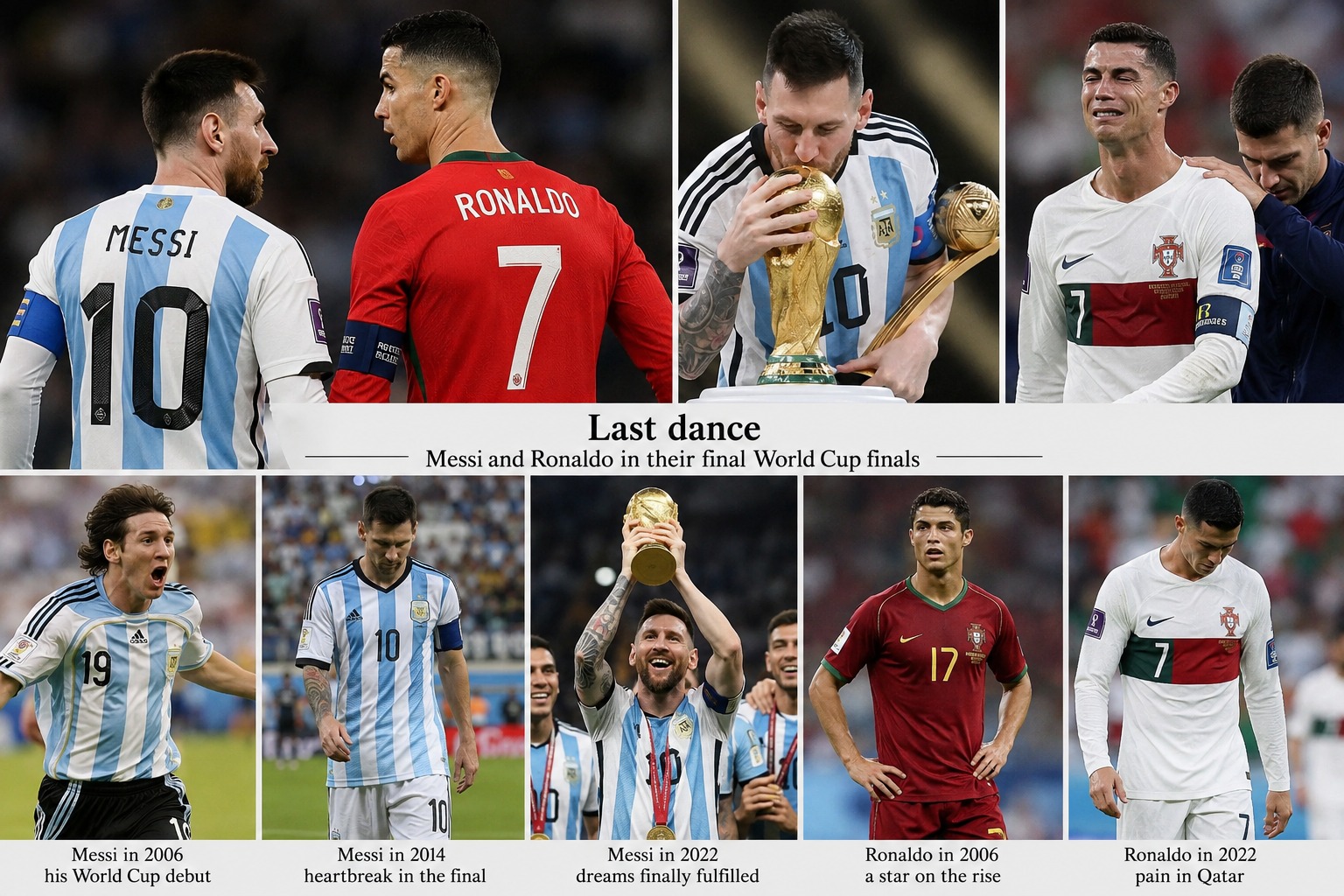
He made his World Cup debut in 2006 in Germany as a young player with huge dreams of following in the footsteps of Diego Maradona.
In a match against Serbia and Montenegro, Messi came off the bench and scored a goal as well as providing an assist within minutes, immediately convincing many that Argentina had found Maradona’s true successor.
However, that first campaign did not end in glory, as Argentina were eliminated by Germany in the quarter-finals on penalties after a 1–1 draw, with Messi remaining on the bench for that match.
Four years later in South Africa in 2010, expectations were even higher due to his outstanding form at FC Barcelona.
Many believed it would be his moment to shine on the World Cup stage, but Argentina once again suffered heartbreak at the hands of Germany, losing 4–0 in the quarter-finals.
Messi did not score a single goal in that tournament despite playing well.
Criticism began to grow, with some claiming he could not carry Argentina in the same way Maradona did in 1986.
Yet despite all the noise, Messi continued to fight, believing that one day he would reach the top of world football.
Pain for Messi
The 2014 World Cup in Brazil was one of Messi’s most significant campaigns with Argentina.
He delivered outstanding performances from the group stage all the way to the final.
He scored in every group stage match, carrying a team under immense pressure from its fans.
The world began to believe that this was finally Messi’s moment to enter football history as Argentina’s greatest player after Maradona.
But in the final against Germany, that dream was shattered in painful fashion.
Argentina missed several key chances, including one clear opportunity for Messi that many believed he would normally score.
In the end, Germany won 1–0 through Mario Götze in extra time.
The image of Messi walking past the World Cup trophy in tears remains one of the most iconic scenes in football history.
Although he won the Golden Ball as the tournament’s best player, his tears showed clearly that the award meant little compared to the World Cup title he had once again missed.
Ronaldo’s Journey
Cristiano Ronaldo’s World Cup story has been different but equally filled with pressure.
He made his debut in 2006 as a young, explosive forward with incredible goal-scoring ability.
In that tournament in Germany, he helped Portugal reach the semi-finals, still one of the country’s greatest ever achievements in World Cup history.
Ronaldo showed strong performances and began establishing himself as one of the world’s best players.
However, the years that followed were far more difficult on the global stage.
Portugal often lacked a squad strong enough to compete with football giants such as Argentina, Brazil, France or Germany.
Ronaldo carried the expectations of his nation for many years.
In the 2010, 2014 and 2018 World Cups, Portugal failed to go far despite his presence.
He was frequently criticised by fans who wanted him to deliver a World Cup title as he had done at club level.
Messi fainally achieves
After years of pain, criticism and near misses, Messi entered the 2022 World Cup with enormous pressure, with many believing it would be his final chance to win football’s greatest prize.
Argentina began the tournament in shocking fashion after losing to Saudi Arabia, creating global headlines.
But from that moment, Messi transformed into a true leader.
He scored crucial goals against Mexico, Australia, the Netherlands, Croatia and France, producing world-class performances throughout.
In the final against France, Messi delivered one of the greatest performances in World Cup history.
He scored twice in a dramatic match that ended 3–3 after extra time.
Argentina eventually triumphed 4–2 on penalties, and the world witnessed the moment millions had waited for: Messi lifting the World Cup trophy.
That victory completed his football legacy. Having already won the Copa América and the Finalissima, the World Cup finally placed him at the very top of football history for many observers.
Ronaldo and the pain of Qatar
While Messi was making history in Qatar, Ronaldo’s experience was very different.
The tournament became one of the most difficult periods of his career.
Before the World Cup began, he was already in a major dispute with Manchester United following a controversial interview.
He arrived in Qatar under intense pressure, with many believing it would mark the end of an era.
He started the tournament well by scoring against Ghana, becoming the first player ever to score in five different World Cups.
However, as the competition progressed, he lost his starting place in the Portugal team.
Coach Fernando Santos began benching him in key matches, sparking global debate.
Portugal were eventually eliminated by Morocco in the quarter-finals.
Ronaldo was seen in tears as he walked off the pitch, a powerful image symbolising the pain of a player who had spent his entire career trying to take his nation to the very top but had fallen short.
Major records set
Few rivalries in football history have produced as many records as Messi and Ronaldo.
Messi has won eight Ballon d’Or awards, while Ronaldo has five.
Both have scored more than 800 career goals, a milestone achieved by very few players in football history.
In the World Cup, Messi holds the record for the most appearances, with 26 matches, and the most Man of the Match awards in the tournament’s history.
He is also the only player ever to score in every stage of a single World Cup tournament.
Ronaldo, on the other hand, became the first player to score in five different World Cups.
Both have now appeared in six World Cups, highlighting their incredible longevity over more than 20 years.
These records underline why their rivalry may never be repeated at the same level.
Last dance 2026
Although many say age is just a number, it is difficult to imagine Messi, now 39, and Ronaldo, 41, being part of their national squads in the next World Cup finals, leading many to believe this will be their final appearance on football’s biggest stage.
Although both are still performing at a high level, time appears to be a force no one can defeat.
That is why the 2026 World Cup is being referred to as their “Last Dance”, marking the end of an era that has dominated world football for more than two decades.
Fan emotions are extremely high because after they leave, football will enter a completely new era.
Young stars such as Kylian Mbappé and Lamine Yamal are seen as the future faces of the game, but many believe it will be extremely difficult to replicate the rivalry between Messi and Ronaldo.
For years, these two players have made the world stop every time they played.
They have touched millions of lives and rewritten football history.
The truth
Regardless of who is considered the better player, one undeniable fact remains: Messi and Ronaldo have completely transformed football history.
They have set new standards in competition, discipline, consistency and success.
They have shown that greatness can last for decades with hard work, dedication and sacrifice.
From Spain to England, Italy, France, the United States and Saudi Arabia, their names have continued to dominate world football for over 20 years.
Now the world waits to see how the curtain will finally fall at the 2026 FIFA World Cup.
Will Messi lead Argentina to defend their world title, or will Ronaldo write a heroic final chapter with Portugal?
No one knows. But one thing is clear: football will never be the same again after they are gone.
Their “Last Dance” is not just the end of a tournament, it is the end of one of the greatest eras ever witnessed in the history of football.