
Dar es Salaam. Tanzania has embarked on a sweeping reform of its tax system after President Samia Suluhu Hassan received a landmark report proposing far-reaching changes aimed at simplifying compliance, widening the tax base and strengthening domestic revenue collection.
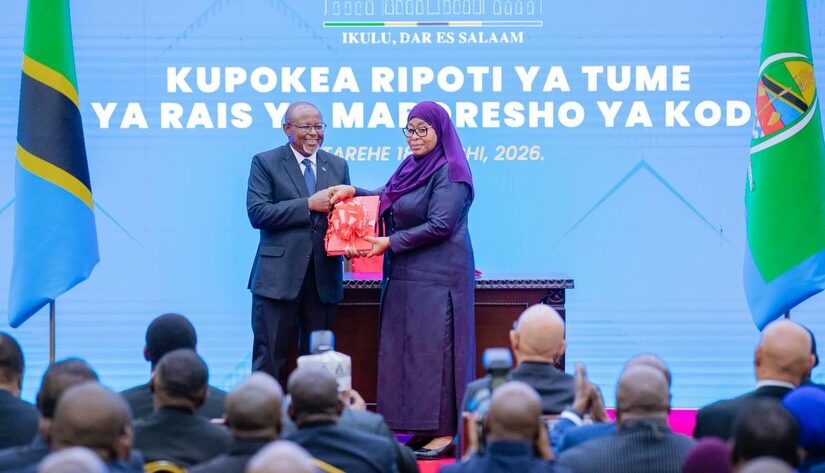
The report, prepared by the Presidential Commission on Tax Reforms, was handed to the Head of State at State House on March 18, 2026.
It sets out a comprehensive roadmap for restructuring the country’s tax framework to reflect current economic realities and support long-term development goals.
Officials say the proposed changes signal a strategic shift from a traditionally enforcement-driven system to one that prioritises service delivery, predictability and taxpayer engagement.
Speaking during the handover, President Samia said the Commission was formed in response to longstanding concerns from citizens, investors and development partners regarding the complexity and perceived inequities within the existing tax regime.
She noted that nearly 35 years have elapsed since the last major review conducted under the Mtei Commission, underscoring the urgency of updating the system to align with a rapidly evolving economy.
The President stressed that the reforms are central to the country’s broader transformation agenda, particularly the implementation of Tanzania Vision 2050, which places significant emphasis on domestic resource mobilisation.
“The private sector must be enabled,” she said, highlighting its expected contribution of about 70 percent towards financing the national vision.
She also commended the Tanzania Revenue Authority (TRA), alongside institutions and taxpayers, for supporting revenue collection through voluntary compliance.
However, she pointed to the need for deeper reforms to expand the formal tax base and unlock untapped potential.
The government is targeting an increase in the tax-to-GDP ratio of 18 percent, a move expected to bolster fiscal stability and reduce reliance on external financing.
President Samia affirmed that the government would move ahead with implementing the Commission’s 284 recommendations through a phased and structured approach covering short-, medium- and long-term interventions.
“Change is necessary and important,” she said, as she emphasized the need for adaptability in response to emerging economic dynamics.
She added that the reformed system will be fair, transparent and easy to navigate, supporting both taxpayers and administrators while fostering business growth.
Presenting the report, Commission Chairperson, Amb Ombeni Sefue, said the review was guided by the need to align taxation with citizens’ expectations and contemporary economic demands.
He stressed that the proposed framework seeks to broaden the tax base, ensure equitable contribution and simplify compliance procedures.
The Commission identified several systemic challenges, including high tax burdens in certain sectors, weak dispute resolution mechanisms, fragmented institutional coordination and a narrow taxpayer base.
Amb Sefue warned that without comprehensive reforms, the country risks continued over-reliance on a small pool of taxpayers, often under burdensome conditions.
He further underscored the importance of balancing revenue mobilisation with economic growth, noting that a supportive tax environment is essential for investment and enterprise development.
According to the Commission, full implementation of the recommendations could raise government revenue by over Sh11 trillion within three years, significantly strengthening the country’s fiscal capacity.
Background to Tanzania’s tax reforms
Tanzania’s tax system has undergone several transformations since independence, with the most significant overhaul taking place in the 1990s during the period of economic liberalisation.
The establishment of the Tanzania Revenue Authority in 1995 marked a major institutional reform aimed at improving efficiency in revenue collection.
Subsequent reforms introduced key measures such as value-added tax (VAT), modernised customs procedures and enhanced enforcement mechanisms.
These changes contributed to improved revenue performance but also introduced new challenges related to compliance and administration.
In recent years, stakeholders have raised concerns over the multiplicity of taxes and levies, frequent policy adjustments and the complexity of filing procedures.
Businesses, in particular, have called for a more predictable and streamlined system.
The government has responded with initiatives such as digital tax administration, electronic fiscal devices and efforts to harmonise local government levies.
However, a large informal sector continues to limit the tax base, while compliance costs remain a concern for formal enterprises.
The current reform initiative is therefore viewed as a comprehensive effort to address both structural and administrative weaknesses, while positioning the tax system to support industrialisation and sustainable economic growth.
Authorities say implementation will be carried out in phases and in consultation with key stakeholders to ensure a smooth transition and broad-based support.
President Samia called for coordinated action across government, the private sector and citizens, noting that the success of the reforms will depend on collective commitment.
The proposed changes are expected to redefine Tanzania’s fiscal landscape, with significant implications for revenue generation, investment and economic competitiveness.