
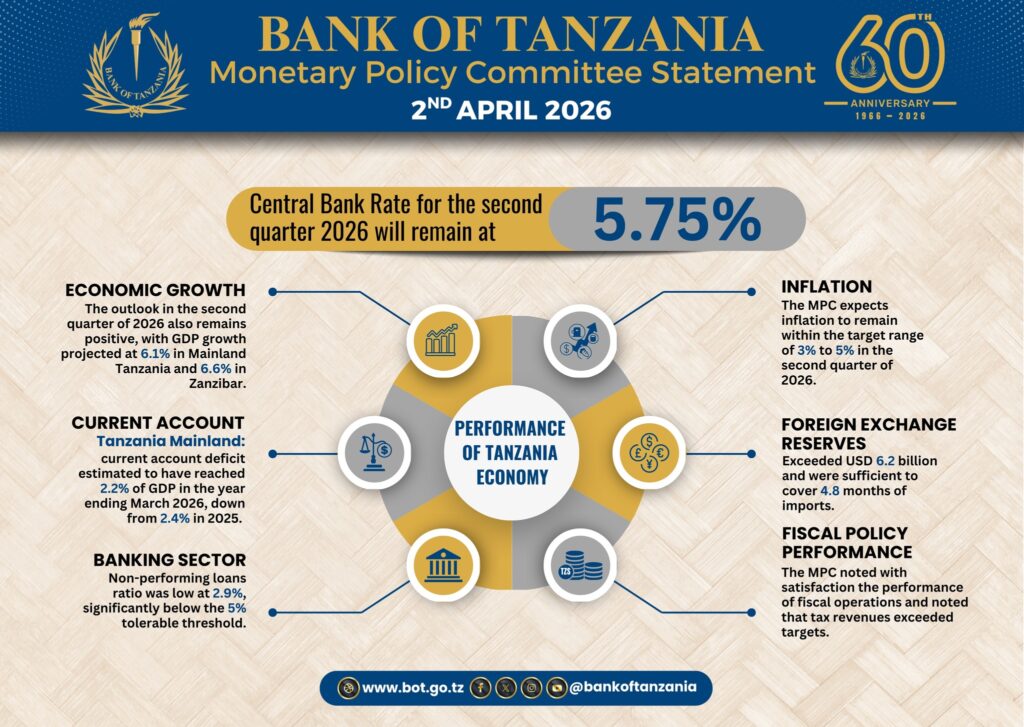
Dar es Salaam. The Bank of Tanzania (BoT) has decided to maintain the Central Bank Rate (CBR) at 5.75 percent for the second quarter of 2026.
This decision follows a Monetary Policy Committee (MPC) meeting held on April 1, 2026 to evaluate the nation’s economic performance.
The primary objective of holding the rate steady is to ensure inflation remains within the target range of 3 to 5 percent.
This move also serves as a strategic buffer against the economic fallout from the ongoing political crisis in the Middle East.
The conflict in the Middle East has already begun to disrupt global supply chains and heighten volatility in international markets.
These geopolitical tensions have contributed to a significant surge in global energy costs.
Notably, crude oil prices jumped from an expected average of $60 per barrel to over $100 per barrel in early 2026.
Domestically, this global trend was reflected in the fuel price increases announced by the Energy and Water Utilities Regulatory Authority (Ewura) in Tanzania on April 1, 2026.
The BoT aims to mitigate the impact of these rising costs on local trade and investment.
To further refine its monetary policy, the MPC has narrowed the policy rate band from +/-2 percentage points to +/-1.5 percentage points. This technical adjustment, effective from April 2026, is designed to improve the efficiency of policy implementation.
Consequently, the interbank cash market rate for seven-day loans is expected to fluctuate between 4.25 percent and 7.25 percent during the second quarter.
Central Bank Deputy Governor, Dr Yamungu Kayandabila, noted that maintaining a stable interest rate environment is supported by robust domestic growth.
Tanzania’s economy continues to show resilience despite external shocks.
In the first quarter of 2026, the mainland economy grew by 6.2 percent, while Zanzibar recorded a growth rate of 6.7 percent.
This expansion has been largely driven by construction, agriculture, tourism, and financial services.
Specifically, the coffee and cashew nut sectors have demonstrated steady growth, contributing significantly to foreign exchange earnings.
Credit to the private sector also remains strong, growing at an average rate of 22.8 percent.
Inflationary pressures have remained contained thus far, with Tanzania Mainland averaging 3.3 percent and Zanzibar at 4.5 percent in the first quarter.
The country’s external position is bolstered by foreign exchange reserves reaching $6.2 billion.
This amount is sufficient to cover approximately 4.8 months of imports, exceeding both legal and regional requirements.
These reserves provide a vital safety net to maintain currency stability and protect the market value of key agricultural exports.
The banking sector remains well-capitalised and liquid, with the non-performing loans ratio dropping to 2.9 percent.
Vice Chairman of the Tanzania Bankers Association, Geofrey Mchangilla, commended the central bank’s oversight.
He said that these measures have strengthened the ability of commercial banks to provide affordable credit.
Continued collaboration between the government and financial institutions is expected to protect economic stability.
The MPC will continue to monitor the Middle East crisis closely ahead of its next meeting in July 2026.