
US President Donald Trump has stated that Iran’s men’s football team is “welcome” at the 2026 FIFA World Cup, but warned that it is “not appropriate” for them to participate due to serious concerns for player safety.
The remarks come amid rising tensions in the Middle East, following US and Israeli strikes on Iran that killed Supreme Leader Ayatollah Ali Khamenei.
In retaliation, Iran launched missile and drone attacks on Israel and four Gulf Arab nations hosting U.S. military bases: Bahrain, Kuwait, Qatar, and the United Arab Emirates.
Iran’s World Cup Plans in Doubt
Iran is scheduled to play New Zealand and Belgium in Los Angeles on June 15 and 21, and Egypt in Seattle on June 26.
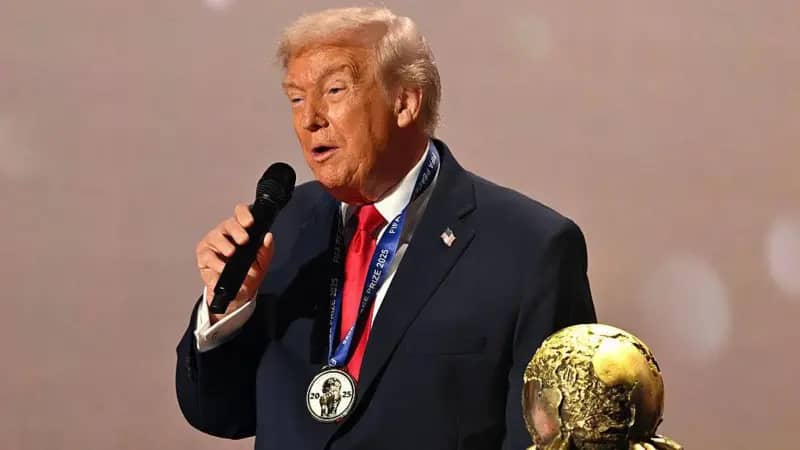
In a post on Truth Social, Trump wrote: “The Iran national soccer team is welcome to the World Cup, but I really don’t believe it is appropriate that they be there, for their own life and safety.”
Earlier this week, FIFA President Gianni Infantino confirmed that Trump had assured him that Iran is “welcome to compete” at the summer finals.
Iran’s Response
Iran’s Minister of Sports and Youth, Ahmad Donyamali, expressed deep concern over the situation in an interview with IRIB Sports Network, saying:
“Given that this corrupt government has assassinated our leader, under no circumstances do we have the appropriate conditions to participate in the World Cup. Our boys are not safe, and conditions for participation do not exist.”
If Iran withdraws from what would be its fourth consecutive World Cup appearance, FIFA regulations allow the governing body to select a replacement team, though no official decision has yet been made.
Historical Context
Iran has a rich history at the World Cup, making its debut in 1978 and qualifying for every tournament since 1998.
Their best performance came in 1998, when they famously defeated the United States 2-1 in a politically charged match. Over the years, the team has become a symbol of national pride, and their withdrawal would be a major blow to Iranian football fans worldwide.
Geopolitical tensions have previously impacted Iran’s sporting participation. In 1980, Iran withdrew from the Asian Cup due to political disputes, and in recent years, international sanctions have complicated travel and funding for the national team.
Analysts warn that if Iran skips the 2026 World Cup, it would not only affect the players but also have a symbolic impact on international perceptions of the country.
Potential Replacements
FIFA rules give the organization discretion to invite a replacement team if a qualified nation withdraws.
Possible contenders could include teams that narrowly missed out during the intercontinental playoffs, though FIFA has not commented on specific options. The decision will need to be made swiftly to allow adequate preparation time for any replacement team.
The Bigger Picture
The situation highlights the intersection of sport and geopolitics, raising questions about safety, diplomacy, and international competition. While the World Cup is often seen as a celebration of global unity, real-world conflicts sometimes intrude, forcing organizers, governments, and athletes to navigate extremely delicate circumstances.
Whether Iran ultimately competes or withdraws, the 2026 tournament will be remembered not just for football but also for the unprecedented geopolitical tensions surrounding one of the world’s most popular teams.