
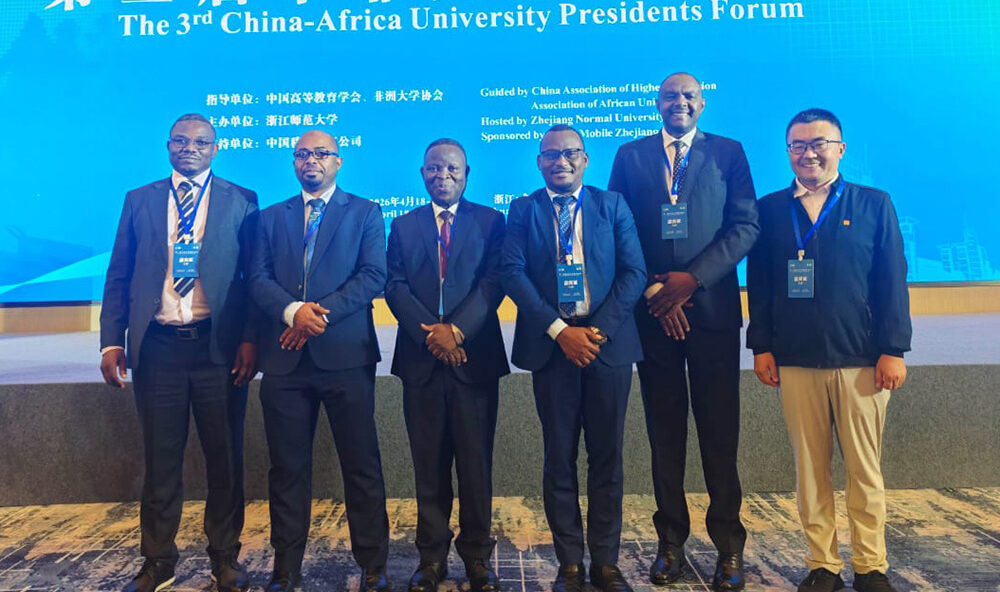
Dar es Salaam. Tanzania is poised to benefit from expanded scholarship opportunities, academic exchanges and capacity building in artificial intelligence (AI), science and technology following the participation of six Tanzanian higher learning institutions and government agencies in the third China-Africa University Presidents Forum held in Jinhua, China.
The forum, which took place from April 14 to 20, 2026, brought together university leaders, scholars and policymakers from across the world under the theme, Synergy, Transformation and Sustainability: Building a New Paradigm for China-Africa Higher Education Cooperation.
Tanzania was represented by senior officials from the Agency for the Development of Educational Management (ADEM), the University of Dar es Salaam (UDSM), Mkwawa University College of Education (MUCE), the Tanzania Institute of Accountancy (TIA), the State University of Zanzibar (SUZA), and the Office of the Treasury Registrar (OTR).
The engagement is expected to strengthen Tanzania’s higher education sector through increased access to international research networks, staff and student mobility programmes, scholarships and technical expertise in emerging fields such as AI, educational technologies, instructional design, leadership and STEM education.
A major outcome of the forum was the appointment of several Tanzanian academics as Researchers under the China-Africa Consortium of Universities Exchange Mechanism by Zhejiang Normal University, a move that embeds Tanzania within a growing international research and innovation network.
Among those appointed were UDSM Vice Chancellor Prof William Anangisye, TIA Rector Prof William Amos Palangyo, MUCE Principal Prof Method Samwel Semiono, ADEM Chief Executive Officer Dr Maulid J Maulid and UDSM College of Engineering and Technology Principal Dr Innocent Macha.
Education stakeholders say the appointments will provide Tanzanian institutions with greater opportunities to participate in collaborative research projects, attract academic resources and strengthen international partnerships.
Prof Anangisye played a prominent role during the forum, presenting a paper titled From Partnership on Paper to Partnership in Practice: Revisiting UDSM’s Digital Education Partnership with Zhejiang Normal University.
He argued that universities must move beyond symbolic agreements and focus on partnerships that deliver measurable outcomes in teaching, research and institutional governance.
“Internationalisation must move beyond agreements on paper to tangible outcomes that transform teaching, research and institutional governance,” he said.
The UDSM Vice Chancellor also delivered a two-day lecture series at the Institute of International and Comparative Education under the theme Reimagining African Higher Education in the Age of AI and Fourth Industrial Revolution: Governance, Curriculum, and Talent Development.
The lectures attracted scholars, researchers and postgraduate students and focused on how African universities can adapt to rapid technological change while maintaining relevance to national development priorities.
Prof Anangisye outlined five strategic pillars that he believes are essential for transforming higher education systems across Africa: relevance, equity, innovation, collaboration and localisation.
He noted that universities must align their academic programmes with labour market demands and socio-economic priorities while maintaining international competitiveness.
“The future of higher education lies in our ability to co-create knowledge across borders while remaining responsive to local realities,” he said.
ADEM Chief Executive Officer Dr Maulid presented a paper titled Synergy to Sustainability: Reimagining Educational Management in Tanzania through Bilateral Partnerships with China.
His presentation focused on how educational leadership and management systems in Tanzania can benefit from international cooperation and knowledge exchange.
MUCE Principal Prof Semiono highlighted the importance of academic partnerships in strengthening institutional capacity and facilitating knowledge transfer between Tanzania and China.
Meanwhile, TIA Rector Prof Palangyo and SUZA Acting Vice Chancellor Prof Abdi T. Abdalla joined high-level roundtable discussions examining future directions for China-Africa higher education cooperation.
The Treasury Registrar, Mr Nehemiah Mchechu, also participated in discussions on strengthening institutional collaboration and expanding opportunities for Tanzanian educational institutions.
On the sidelines of the forum, SUZA held discussions with leaders of schools and research institutes at Zhejiang Normal University aimed at broadening cooperation into science, engineering, research and academic exchange programmes.
The talks build on an existing partnership between the two institutions through the Confucius Classroom at SUZA, which promotes Chinese language and cultural studies.
The programme has contributed to strengthening language skills and intercultural understanding, particularly in support of Zanzibar’s tourism sector and international engagement.
The forum formed part of the celebrations marking the 70th anniversary of Zhejiang Normal University and was attended by hundreds of participants from around the world.
The event also aligns with the China-Africa Year of People-to-People Exchanges 2026, which seeks to deepen cooperation through education, culture, research and innovation.
For Tanzania, participants said the engagement represents more than academic diplomacy.
It offers practical opportunities to improve teaching quality, expand research collaboration, develop digital education systems and equip students with skills required in an increasingly technology-driven global economy.
As the country seeks to accelerate industrialisation and strengthen its knowledge economy, the partnerships forged in China are expected to support the development of a more globally connected and future-ready higher education sector.