
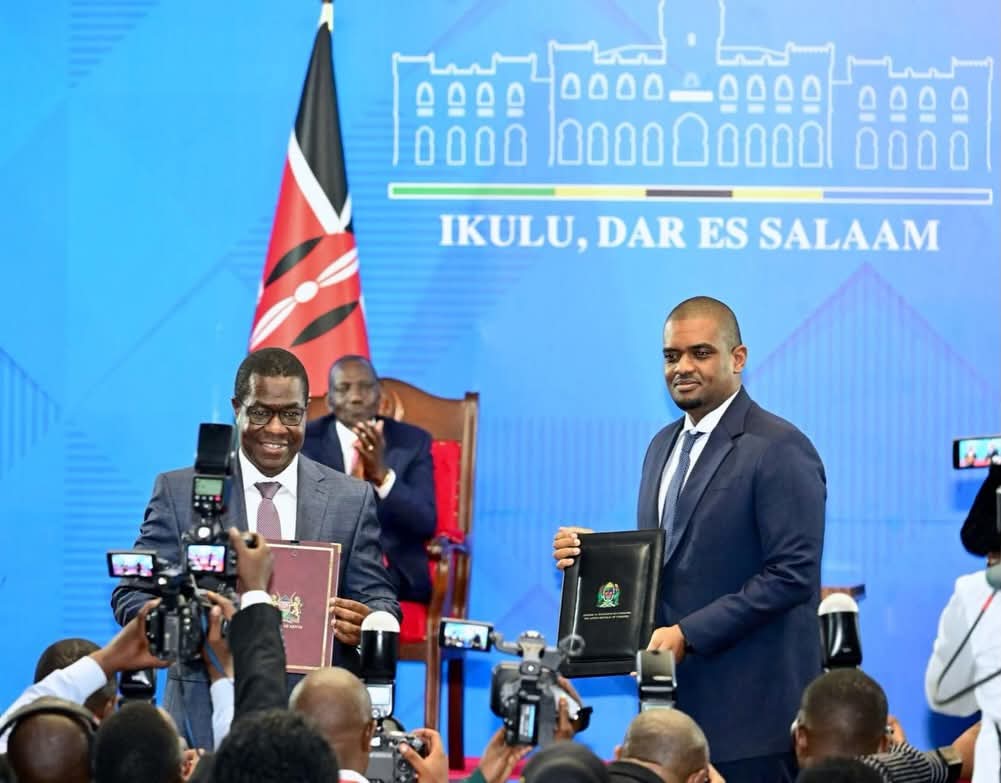
Dar es Salaam. President Samia Suluhu Hassan and her Kenyan counterpart William Samoei Ruto on Monday, May 4, 2026, witnessed the signing of a key energy cooperation agreement.
The agreement, between Tanzania and Kenya, marks a renewed push to deepen bilateral ties and resolve trade barriers.
It was signed at State House in Dar es Salaam by Tanzania’s Energy Minister, Deogratius Ndejembi, and Kenya’s Cabinet Secretary for Energy and Petroleum, Opiyo Wandayi.
It provides for the commencement of cross-border electricity trade and a feasibility study for a natural gas pipeline linking Dar es Salaam to Mombasa.
The signing formed part of a broader package of eight agreements concluded during President Ruto’s two-day state visit.
The accords span trade, infrastructure, energy, agriculture, security, and public sector cooperation.
Under the energy pact, the two countries agreed to initiate electricity trading arrangements to improve power reliability and support industrial expansion.
The agreement also sets out a joint feasibility study for the proposed Dar es Salaam–Mombasa natural gas pipeline.
Officials said the study will assess the technical, economic and environmental viability of the project.
They noted that, if implemented, the pipeline could strengthen regional energy integration and facilitate efficient gas distribution along the East African coast.
The development follows bilateral talks between the two Heads of State, including a private meeting and official discussions, before the signing ceremony.
The leaders later briefed the press on measures to accelerate cooperation.
President Samia and President Ruto agreed to clear outstanding non-tariff barriers by the end of May 2026.
They directed that the Joint Trade Committee convene regularly to resolve bottlenecks and prevent new ones.
President Ruto said Tanzania and Kenya are interdependent economies that must move from administrative constraints towards trade facilitation.
He noted that inefficiencies continue to affect the flow of goods and services.
He said bilateral trade reached $860 million in 2025.
He added that it could have exceeded one billion US dollars in the absence of non-tariff barriers.
Beyond the energy agreement, the eight accords cover railway cooperation, maritime transport, standards alignment, mutual legal assistance in criminal matters, and recognition of seafarers’ certificates.
They also include capacity-building initiatives in public service.
The leaders also reviewed priority infrastructure projects.
These include power interconnection, railway links through northern Tanzania, and road corridors connecting Dar es Salaam to Mombasa.
Later, the two presidents attended the Tanzania–Kenya Business Forum.
The event brought together government officials, investors and private sector actors from both countries.
Addressing the forum, President Samia said Tanzania would continue working with Kenya to harmonise laws and regulatory systems.
She said infrastructure development remains essential for unlocking cross-border trade and investment.
President Ruto said the two countries could raise trade volumes to $1 billion and attract up to $500 million in new cross-border investment within three years if barriers are removed.
Business leaders from both sides called for closer cooperation in manufacturing, energy, finance, agriculture, infrastructure and services.
They stressed the need for predictable policies and efficient logistics systems.
The agreements signal a renewed commitment by Tanzania and Kenya to strengthen economic cooperation and advance regional integration.