
Africa has reached a historic milestone at the 2026 FIFA World Cup, with a record 10 nations representing the continent at football’s biggest tournament.
The competition gets underway in North America on Thursday, June 11, 2026 with South Africa facing co-hosts Mexico in the opening match.
For the first time in World Cup history, Africa will have double-digit representation on the global stage following FIFA’s expansion of the tournament from 32 to 48 teams.
Algeria, Cape Verde, Côte d’Ivoire, DR Congo, Egypt, Ghana, Morocco, Senegal, South Africa and Tunisia will carry the continent’s hopes across Canada, Mexico and the United States.
The achievement marks another significant chapter in African football’s rise, coming four years after Morocco became the first African nation to reach a World Cup semi-final at Qatar 2022.
With more places available than ever before, Africa now has its greatest opportunity yet to challenge for honours and further strengthen its position among world football’s leading regions.
A long journey to record representation
Africa’s World Cup story began in 1934 when Egypt became the first African nation to appear at the finals in Italy.
Progress was gradual. Morocco became the continent’s second representative in 1970 before DR Congo, then competing as Zaire, qualified in 1974.
Tunisia followed in 1978, while Algeria and Cameroon featured in the 1982 tournament.
By 1998, Africa had secured five places at the World Cup for the first time, represented by Cameroon, Morocco, Nigeria, South Africa and Tunisia.
The continent maintained five qualification slots through several editions, producing memorable performances but often falling short of a place in the latter stages.
The previous record came in 2010 when South Africa hosted the tournament and Africa fielded six teams Algeria, Cameroon, Côte d’Ivoire, Ghana, Nigeria and South Africa.
Ghana came closest to making history that year, reaching the quarter-finals before suffering a heartbreaking penalty shoot-out defeat to Uruguay.
Morocco’s historic breakthrough
African football’s global standing was transformed at the 2022 World Cup in Qatar when Morocco became the first African and Arab nation to reach the semi-finals.
The Atlas Lions defeated Belgium, Spain and Portugal on their remarkable journey to the last four, proving that African teams could compete with and overcome football’s traditional powers.
That achievement altered perceptions worldwide and raised expectations ahead of the 2026 tournament.
Newcomers add fresh hope
Among the most compelling stories of the 2026 World Cup is Cape Verde’s historic qualification.
The island nation will make its debut appearance on football’s grandest stage.
DR Congo also return to the tournament for the first time since 1974, ending a 52-year absence and adding further intrigue to Africa’s challenge.
South Africa’s return is equally significant.
Bafana Bafana are back at the World Cup for the first time since hosting the competition in 2010 and will launch Africa’s campaign against Mexico in the opening fixture.
Meanwhile, Algeria, Côte d’Ivoire, Egypt, Ghana, Morocco, Senegal and Tunisia bring valuable World Cup experience and will be expected to spearhead the continent’s push for success.
Higher expectations for Africa
For Africa, the 2026 FIFA World Cup is about far more than record participation.
The continent arrives in North America with unprecedented representation, but also with greater expectations.
The challenge now is to convert record numbers into record performances.
After decades of near misses, dramatic exits and unforgettable moments, African football enters the tournament with its strongest presence yet and genuine belief that another historic breakthrough is possible.
From Egypt’s pioneering appearance in 1934 to a record 10 nations in 2026, Africa’s World Cup journey has been long, difficult and inspiring.
Now the continent has another opportunity to demonstrate that its place in world football is not only growing in size, but also in ambition and achievement.
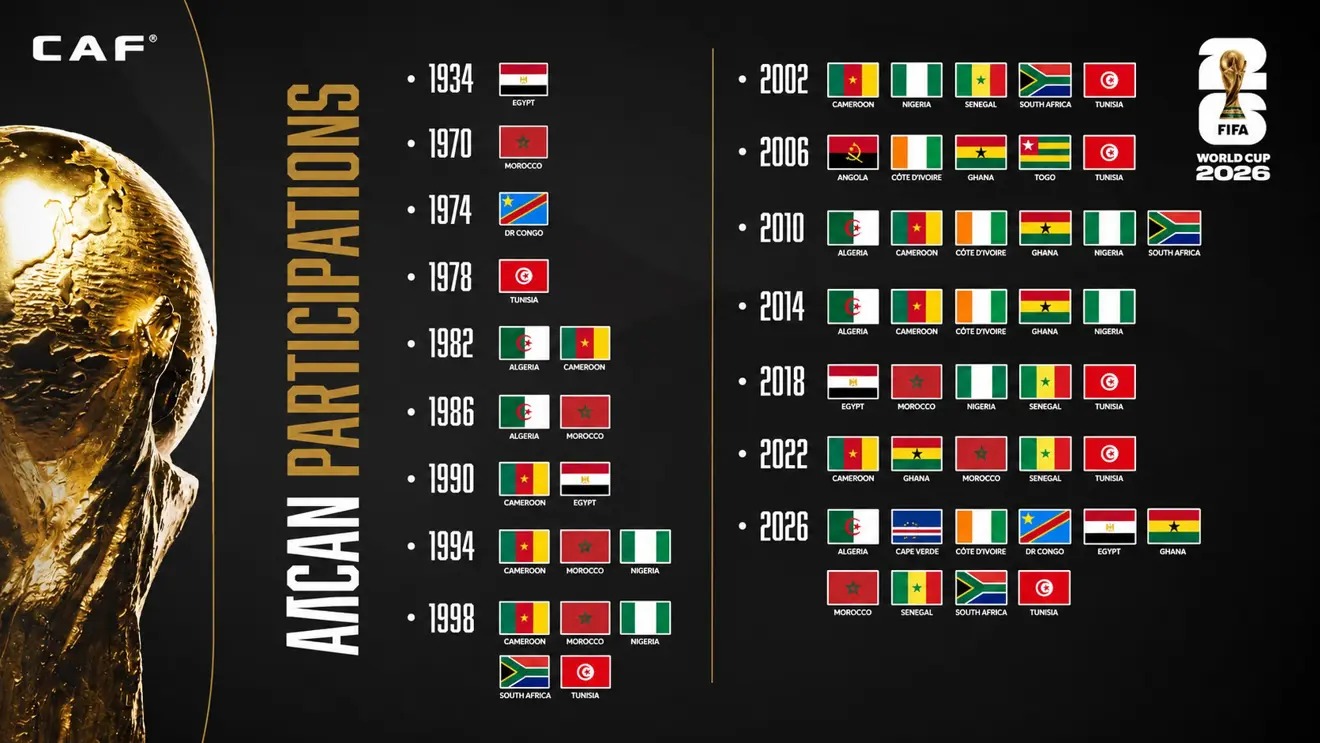
African participation at the FIFA World Cup
1934: Egypt
1970: Morocco
1974: DR Congo
1978: Tunisia
1982: Algeria, Cameroon
1986: Algeria, Morocco
1990: Cameroon, Egypt
1994: Cameroon, Morocco, Nigeria
1998: Cameroon, Morocco, Nigeria, South Africa, Tunisia
2002: Cameroon, Nigeria, Senegal, South Africa, Tunisia
2006: Angola, Côte d’Ivoire, Ghana, Togo, Tunisia
2010: Algeria, Cameroon, Côte d’Ivoire, Ghana, Nigeria, South Africa
2014: Algeria, Cameroon, Côte d’Ivoire, Ghana, Nigeria
2018: Egypt, Morocco, Nigeria, Senegal, Tunisia
2022: Cameroon, Ghana, Morocco, Senegal, Tunisia
2026: Algeria, Cape Verde, Côte d’Ivoire, DR Congo, Egypt, Ghana, Morocco, Senegal, South Africa, Tunisia